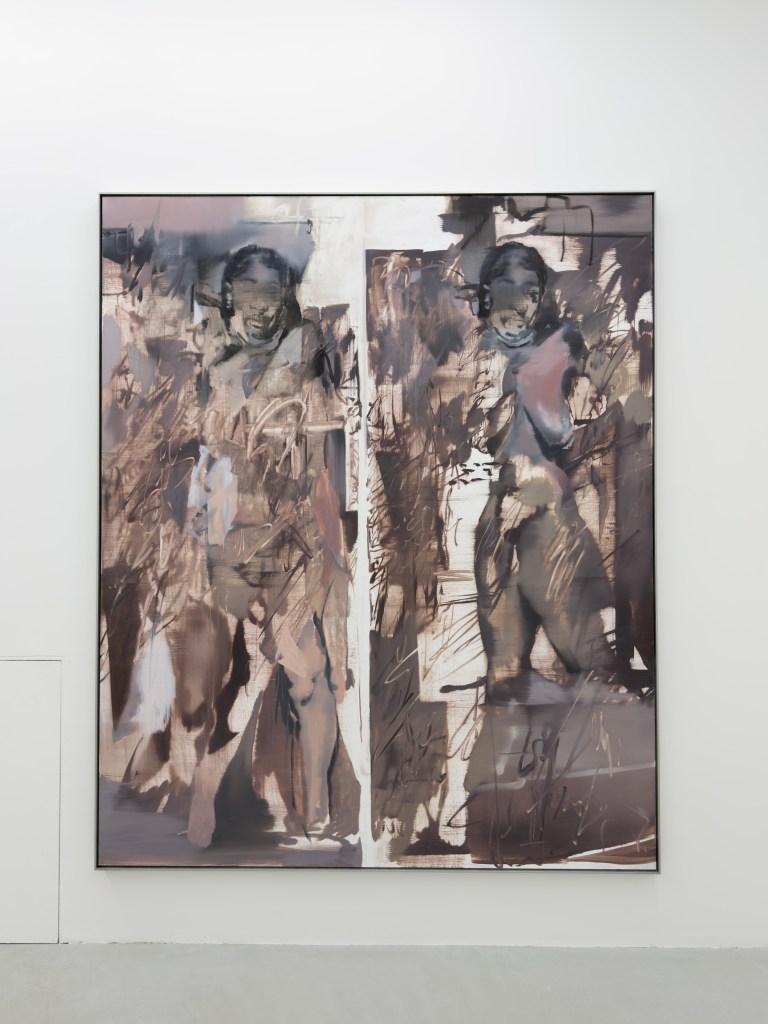
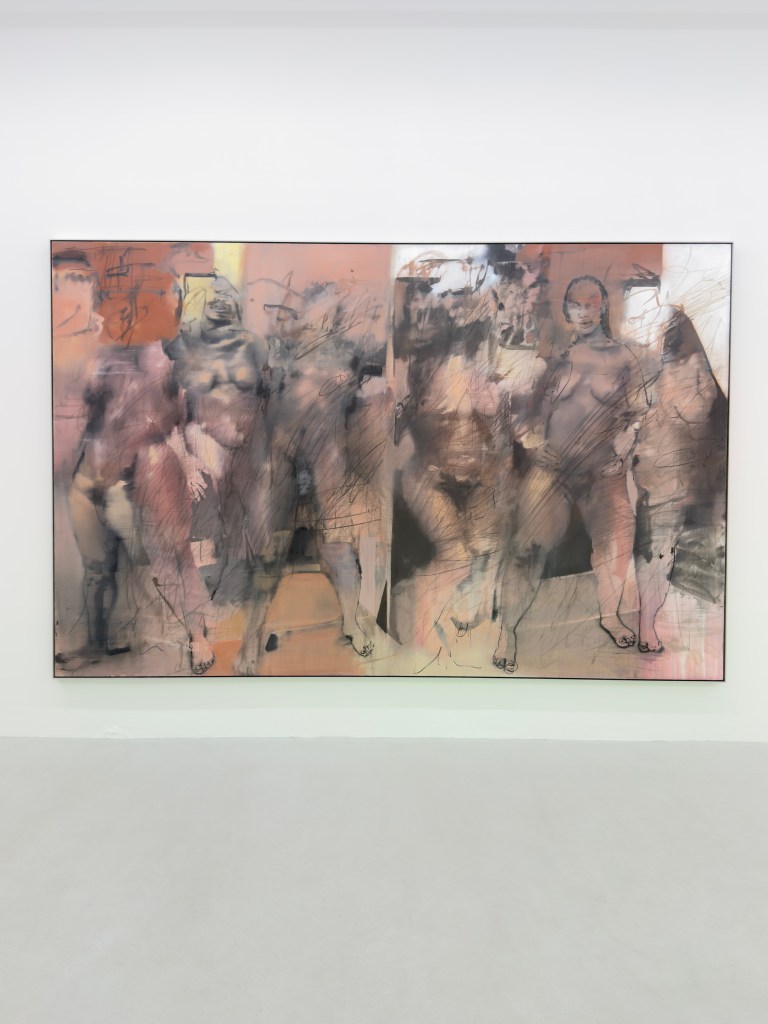
In 1897 Paul Gauguin asked the questions “where do we come from? What are we? Where are we going?”. Gauguin’s work answered none of those questions and in George Rouy’s ‘Reprise’ exhibition, a direct answer is still out of reach. Despite their differences, both artists concede the destination, for all its emotive force of struggle and triumph, is secondary. Instead, what we have are portrayals where primacy is given to the process of transformation, change – becoming. But this development of the self isn’t a straight forward development in Rouy’s work like that of Gauguin’s. What we see before us is a disintegrated and incomplete depiction of the self.
Paul Gauguin, “Where do we come from? What are we? Where are we going?” 1897-98
Oil on canvas
139 cm × 375 cm
Rouy’s philosophical arc centres itself on this evolutionary process of becoming. The body is always in the throes of becoming, a process bound up in struggle, where the body is said to be at ‘war’ with itself. A second dimension of Rouy’s philosophy concerns repetition, which doesn’t take on its usual synonyms of inertia and consistency in his oeuvre. Repetition is the site of transformation and change – instability. Despite taking inspiration from Deleuze in this vein, Heraclitus observed that we are never the same people at two instances in time and the environment surrounding us is never the same either. With the underlying mechanics of our world being defined by flux where nothing is and everything changes; the only constant is there are no constants. Our sense of identity or self-formation then is not a fixed entity going through time. It is dynamic, responding to flux as we pass through time. Flux is both within and without our control – a paradoxical reality of life. The flux we experience throughout our lives isn’t just a source of physical struggle, but also psychic. Asking the questions that Gauguin asked, how do we form a cohesive sense of self in past, present and future? How do we form a sense of identity without full control of the narrative?
The act of ‘Reprise’, the name of the exhibition, is to return to something, to take up again at two different instances in time. When we take into account that we are never the same people, same states of mind, at two different instances in time, the act of ‘reprise’ – repetition – takes on a life of its own. Each time we repeat, we are approaching the problem or task from a different, or unique, perspective. This possibility provides the scope for change, transformation – the ability to apply different solutions to the same task. This scaffolding that Rouy builds means that two instances of ourselves at separate moments in time are unexchangeable, indivisible – asymmetric. Just as Heraclitus acknowledges ourselves to be different through time, but also the river we step into – identity at one moment in time is not an exchangeable quantity at another moment in time. How we define ourselves, even in the face of repetition, isn’t a simple process. Through time we are multi-faceted. In Reprise (2026) and The Split (2026), Rouy brings this sensibility to life with the asymmetry between the figures in each scene. These works build into this sense of the body, both physically and psychically, being at ‘war’ in this process of self-determination and self-formation.
Reprise (2026) is a glitch; what we see on the canvas are two separate projections, each side advancing different visualisations of the same reality. There is no shared consistency, even between these projections; the poses are contorted in different directions, alternating parts of their bodies are accentuated. Outlines of disproportionate legs, a deformed torso almost melting, smudged faces – similar to Bacon’s work – all enmeshed within this noise of abstract detail that at once contains and annihilates the figure. Calligraphic scratching, echoing Twombly, is spread inconsistently across the canvas. It works to create a restlessness that makes a focal hierarchy difficult to reconcile, our eyes refusing to settle on any specific point on the canvas. Not because the painting is disordered, but because there is no single cohesive self in it to look at. The palette deployed is austere; greys, monochromes, bruised tones withdraw into sepia. The bleaching creates a skeletal effect, emphasising the high-octane swirls from calligraphic marks. Together, the energy created is like that of a static television screen; pent up pixels scrambling, arriving everywhere yet going nowhere. Nowhere to exert themselves but towards you, the viewer.
In The Split (2026) we have the same border drawn down the middle of the canvas, separating two frames at the same instance in time. Three figures on either side of the panel, standing in bold contrapposto stances. A blur of movement prevails, split frames appearing at the same moment in time but producing different results on either side of the canvas. Rouy’s signature bleed technique comes into its own in The Split, with details coming into view, but never quite resolving themselves to the viewer. There is the appearance of an entity, but no full delivery of form. They are apparitions coming into existence but withdrawing themselves simultaneously. Throughout both The Split (2026) and REPRISE (2026), the human form never fully reconciles itself; a stylistic feature that characterises many of Rouy’s works. The effect of the blur, mixed with partially developed human form leaves me with the impression of vacuity, the state of being incomplete. We are in the process of becoming whole and Rouy’s work captures the nature of that process in this technique. The glitching, alongside the bleed, build into this idea that we are a dynamic mirage of fragments through time but never a static whole.
The stage of becoming is more important than the destination. Gauguin emphasised this by portraying different stages of the human condition through time in a single frieze, Rouy’s REPRISE (2026) and The Split (2026) demonstrates multiple dimensions of the same condition competing at the same time. The impact of these split frames is spatiotemporal collapse with two instances in time captured in the same physical space. Gauguin expressed whole scenes related to concrete stages of our life cycle in separate frames of the canvas. Rouy, on the other hand, deconstructs only the human figure, the site of the individual – leaving only energetic signatures, ghosts, to contend with. The self, in this process, is not a cohesive, linearly developed whole like that of Gauguin’s. The state of becoming Rouy depicts resembles that of a conjunction of fragmented instances of the self through the same moment in time. In Gauguin’s work, the self is undivided through time. In Rouy’s, the self is fractionalised.
George Rouy, Unknown III, 2026
Graphite spray and oil on canvas
50.1 x 40.4 x 1.2cm
In a show where real bodies blur, bleed, split and refuse to resolve, the only fully developed face belongs to no one. Compared to the other paintings, Unknown III is drowned out based on its scale – looking like a study rather than finished piece. It’s described as an ‘anti-portrait’, yet when considering all the other works surrounding it – its the only work that features a face, or at least a wholly developed face for the viewer to concentrate their gaze. This piece is a composite of bot identities, not grounded in a real person, but in a computer generated fabrication. A simulacrum; a painting without a stable origin in concrete reality. In the age of proliferating images, rampant media consumption – this piece feels like Rouy is in the process of developing another dimension of identity. That of the image existing independently of reality such as social media profiles and performative selves; this constructed face owes nothing to a referent but is believed anyway. The other works in this exhibition fracture a self that exists; this one gives coherent form to a self that doesn’t.
When I turn back to where we started, comparing Gauguin’s portrayal and Rouy’s, the difference isn’t that of style alone. The process of becoming hasn’t changed, we are still going through the same motions, the same challenges. What comparing these artists does is serve to highlight that the nature in which these challenges manifest is fundamentally different. That difference leaves us with a question, the same question that one of the gallerists asked me, do we ever fully become? It seems to me the reconciliation of that question is harder now, not because we have further to travel, but because the ground keeps moving underneath. In ‘Reprise’, Rouy demonstrates this reality with precision, both psychically and physically.
References
Baudrillard, Jean. Simulacra and Simulation. Translated by Sheila Faria Glaser. Ann Arbor: University of Michigan Press, 1994. Originally published as Simulacres et simulation (Paris: Galilée, 1981).
Deleuze, Gilles. Difference and Repetition. Translated by Paul Patton. New York: Columbia University Press, 1994. Originally published as Différence et répétition (Paris: Presses Universitaires de France, 1968).
Gauguin, Paul. D’où venons-nous? Que sommes-nous? Où allons-nous? (Where Do We Come From? What Are We? Where Are We Going?). 1897–98. Oil on canvas, 139.1 × 374.6 cm. Museum of Fine Arts, Boston, Tompkins Collection—Arthur Gordon Tompkins Fund, 36.270.
Some artworks push the boundaries of technique; others ignite profound shifts in a society’s values and beliefs, becoming turning points in how we see our world and ourselves. Picasso’s Les Demoiselles d’Avignon (1907) and Jenny Saville’s Odalisque (2012-14), though separated by more than a century, move in remarkable dialogue. Each confronts and disrupts prevailing beliefs and values surrounding beauty, representation, and most critically the gaze that helped shape them. Our belief systems are formed through our shared education, family life, socialisation, and lived experience. These beliefs, in turn, shape our values – the principles and standards by which we judge worth – and those values guide our actions, how we operationalise our beliefs. Artists, at their core, translate these inner beliefs into form, inscribing their truths on paper, canvas, sculpture.
In Les Demoiselles d’Avignon, Picasso threw the gauntlet of liberty at his viewers by challenging socially ingrained beliefs concerning female representation and beauty, shaped by early 20th-century Parisian culture. This act of liberty – a break from classical form, narrative and moral expectation – was blunt, unapologetic and revolutionary. Saville, on the other hand, does not smite her viewers in the same way Picasso once did. Instead, Saville offers an olive branch of justice to her viewers – a form of tough love. Justice here being the presention of a perspective, without jolting the viewer but gently enticing them to see our collective point of view. That view being a direct challenge to the male gaze; whereby women are framed as objects for male pleasure, shaping representation through patriarchal perspectives. Picasso once liberated us from beliefs and values surrounding convention, Saville coaxes us away from societal expectations around ideals of beauty in favour of humanist beliefs and values. Her work embodies restorative representation of the human form – a representation of the human form that speaks of the lived experience, not of idolisation. In the same vein, these works are challenging the same ideals, albeit in contextually different circumstances.
This essay will explore how these two works are aligned in terms of their significance, how each marks a decisive redefinition of what it means to depict the human form and, as a consequence, what this means for our collective beliefs and values. This essay considers not only how Saville and Picasso disrupted artistic traditions, but also how their works reflect the belief systems and values shaped by the societies in which they were made. The difference between Les Demoiselles d’Avignon and Odalisque lies within the method of expression, how reality is presented, but Saville’s development on Picasso is not about pushing the medium forward but about communicating a message in a much more enticing and subtle way. We will explore the ways in which they communicate these truths, regarding beliefs and values surrounding idealised notions of beauty, alongside how and why their expression differs.
Advancing from Abstraction to Pictorial Reality
Saville’s work is significant as it confirms that our concern, as viewers of art, no longer lies wholly with the medium itself. Much attention has been given to the fundamental changes within the delivery of expression; specific brushstrokes, the way in which paint is laid on canvas, what those changes mean from the perspective of the artist’s intention and how, in turn, this relates back to society. We are now beyond utilising this oeuvre for defining seminal works. Marshall McLuhan famously argued “the medium is the message”, meaning that the medium through which a work is conveyed shapes and often determines the nature of its content. Yet in the contemporary moment, media is insufficient in delivering the whole message; our engagement is now dependent upon the underlying beliefs, and values, a work of art communicates to us. Saville’s Odalisque exemplifies this shift, using the medium not as the central statement but as a vessel for layered social commentary.
If we were only to be concerned with the so called ‘progression’ of media, then I believe we have reached our expressive ‘peak’ with Rothko, Pollock – most notably, Twombly. These were the final surrenders in the progression of the medium of paint, the final deliveries of expression in abstract form. But, as McLuhan suggested, once we shape our tools, those tools shape us; the possibilities and limitations of abstraction have now shaped our expectations as viewers. In our present moment, the messages we need to communicate are more nuanced and inherently more complex, mirroring the levels of complexity that surround us in society. The human condition is no longer a linear path of progression, where we required only a simple window from art in order to understand our environment. It is full of twists, ruptures, and intricate details that we must not miss if we are to truly understand our environment. What is required from art is no longer a window, but a mirror – not a passive view into reality, but a reflection of the irregularities, contradictions, and complexities of modern existence. While Abstract Expressionism, within the Postmodernist paradigm, brought us to a critical point in freeing art from representation, it is now necessary to return to pictorial realities – but with an approach freed from the male gaze that dominated much pre-Abstract Expressionist art.
Abstract Expressionism – by removing the figure – disrupted centuries of objectification of female form, yet its non-representational language no longer suffices for the messages we need to communicate. What once freed art from convention now risks alienating the viewer. This is because the message that needs to be communicated now is more sophisticated than pure emotion; they must engage both the rational, analytical parts of our minds and the emotional. Abstraction excelled at the expediency of “seeing and feeling” – stripping experience down to its emotive core – but that very efficiency is not a limitation. In our present complexity, we require art that compels us to see, think, and feel, as we did at the turn of the twentieth century, when pictorial representation could operate on both cognitive and emotional levels.
Out of necessity, many artists since the post-war period have returned to the figure and to recognisable forms – not in service of idealisation, but as a means to grapple with the anomie and alienation of modern life. We are required to go back to pictorial representations of the way things are in order to achieve a universally identifiable form of communication once again. This is a movement that has been in progress since the post-war period; artists such as Picasso and later, Richard Diebenkorn with Girl looking at landscape(1957), Woman in a window (1957) and reclining nude (1962), alongside artists such as Lucien Freud began to reintroduce the figure as a site of psychological complexity. Their work voiced dissatisfaction with the dominance of the male gaze and sought new ways of representing the human subject that could encompass vulnerability, estrangement and existential uncertainty. The culmination of this ongoing movement – the point at which the return to figuration reaches its fullest expressive and critical potential – can be found in Jenny Saville’s Odalisque.
This New Figuration movement started in the late 1950’s and rejected ‘impersonal’ abstractions of its era, emphasising the most devastating parts of the human condition: anomie, isolation, estrangement and loss of spiritual meaning. With abstraction erasing the human figure from artworks entirely, a certain wondering arose: if we are no longer represented in art, what happens to the human subject – and to the viewer? In other words, where has wo-man gone, and where will wo-man go?
Pictorial representation – whether through painting, drawing, sculpture – gives the artist broader scope for communicating truths with a richness that pure abstraction, for all its emotive force, cannot match. Yet pictorial realities are not expedient forms of communication, the message of what values are being conveyed are more hidden, harder to discern – and herein lies the glory. That understanding, that recognition of values is hard won. Unlike in Abstraction Expressionism, emotion is not channelled directly; we must work to uncover the truth the artist is offering. This is tough love in visual form – justice rendered in paint. The artist gives you the tools, and the challenge, to discover meaning for us.
The values we talk about here are the principles that drive the message, and ultimately, the artist’s intention. These values are shaped by societal institutions, education and lived experience – forces that inform the mind and the hand of the artist. To take the Marxist stance of Berger and Clark, they are the underlying determinants of artistic expression. In this sense, values and beliefs are not background influences but the very engine of the artists intention, of creation: the philosophy, the metaphysics, that brings an image into being. The artist’s intention is to communicate a message to you – to connect with the values in your own mind as a viewer. This is what great art is about: the pure relationship between what is seen, the one who sees it and what is understood as a result of that exchange. By returning back to pictorial representation, Saville shifts our attention away from medium and form toward the underlying message, inviting us to confront the values her work brings to the surface.
The stark contrast between Picasso and Saville – positioned at opposing ends of the spectrum of artistic expression – reveals just how far society has come in the last hundred years. In Les Demoiselles d’Avignon, Picasso embraced cubism; an art style that shows subjects from multiple perspectives using abstract, geometric forms. This marked the starting point of abstraction and struck directly at the conventions of his time whereby Picasso stunted conventionality. Saville, by contrast, has moved us back toward pictorial reality. Her delivery is more subtle, based in a universally recognisable form. In 1907, Cubism’s visual fragmentation mirrored the first tremors of a pluralistic society – a visual code understood only by a few. Today, in a world already fragmented, Saville’s pictorial realism speaks to everyone, offering a shared visual ground from which to confront our values. To see where the real weight of where these works lie, we must now turn to the canvases themselves – the places where this century-long journey from liberty to justice takes visible, tangible form.
Picasso, Pablo. Les Demoiselles d’Avignon. 1907, oil on canvas, 243.9 × 233.7 cm. Museum of Modern Art, New York. Photo by James Parsonage, 2023.
Picasso’s presentation of “ladies of the night” in Les Demoiselles d’Avignon was nothing short of a provocation to polite society. Rather than rendering them as delicate, submissive and in a position of inferiority relative to others – the pose expected of women in art at the time – Picasso shows them upright, robust, and unflinchingly present. This reverses the traditional power dynamics between sex workers and the male gaze, overturning centuries of imagery in which such women were objects of desire or moral judgement. Here, sensuality gives way to raw human dignity and confrontation. Their faces are expressionless, with tired yet steady eyes; they do not gaze seductively, they stare. That stare meets the viewer without warmth or seduction, forcing the unsettling sense of being observed. This reversal strips the viewer of the usual control, and in its place, we find solidarity: five figures bound by shared resistance and experience. It is a rebellion in its most unvarnished form – liberty on stretched canvas, laid down in thick, matte paint. There is no glamour here, only humanity. This is a direct challenge to traditional ideals of beauty and what qualifies as “worthy” subject matter, a demand that we reconsider the beliefs and values society hands down to us. Early signs of this shift can be seen in Ingres’ La Grande Odalisque (1814), a work still deeply embedded in the male gaze but quietly resistant: the figure’s back is turned, her gaze averted, her most idealised features concealed. Ingres’s protest was subtle. Picasso’s is blunt. Les Demoiselles d’Avignon embraces defiance without fear.
These ideas are reinforced through the painting’s abrupt, angular forms and Iberian mask–inspired faces. Such geometric reduction smashes Renaissance-derived perspective and distorts human anatomy, dismantling the conventions of idealised beauty and, with them, the polite fiction of “civilised” representation. In 1907, Picasso had recently encountered Iberian sculpture at the Louvre and ethnographic artefacts from Africa in Paris museums — works filtered through colonial acquisition and displayed as exotic curiosities. By integrating these so-called “primitive” forms into his avant-garde vocabulary, he not only disrupted European pictorial norms but also inserted aesthetics associated with marginalised cultures into the centre of modernist innovation. The effect is a jarring belief shift: an invitation to examine why we accept certain ideals as “good” or “proper” and to consider the possibility of returning to something rawer and less constrained — a kind of hiraeth for our origins in nature. This is freedom on canvas: the refusal to take inherited standards at face value, whether they concern beauty, class, nationality, or physical appearance, and the insistence on valuing human beings for their lived reality. Picasso delivers this message as a violent rupture in thought. The colours are dissonant, even illogical, refusing harmonious resolution. The matte surface strips away any sense of polish or seduction. This is not an image of glamour, fame, or fortune; it is an unflinching statement of honesty, a confrontation with who we are, where we have come from, and where we might go — and a challenge to understand our beliefs and values rather than passively inheriting them.
Some might rush to judgement on this, quoting Picasso:
“I think that everything is unknown, everything the enemy! Everything! Not just some things – women, babies, animals, tobacco, games… Everything!”[1]
When we introduce Gertrude Stein’s reflections on Picasso, a close confidant of his, there is a philosophical lens that deepens our understanding of Les Demoiselles d’Avignon. She observed in her book on Picasso “the painter does not conceive himself as existing in himself, he lives in the reflections of his pictures” and that his long struggle was “not to express what he could see but not to express the things he did not see – that is to say, the things everybody is certain of seeing but which they do not really see”[2]. If we take ‘reflection’ in its optical sense, it is never a neutral copy; it is a reversal, an inversion of the original. In 1907 Paris, the social set of beliefs and values – reinforced by politics, culture and economics – cast women, especially sex workers, as submissive, idealised and existing for male pleasure. In Picasso’s reflected world, those values are turned inside out. The women of Les Demoiselles confront rather than submit, they occupy the visual and psychological space typically held for the male gaze; their power is active, not passive.
Seen through Stein’s lens, Picasso inhabits the rules of this inverted reality whilst he paints, making that reversal his operative truth, irrespective of personal beliefs outside the studio. The beliefs of passivity, compliance and objectification are supplanted in the reflected world by values of agency, dignity and defiance. For the viewer, to enter the painting is to enter its rules, where inherited certainties no longer hold. Here, the conventions that once dictated what a woman must be seen as are stripped away, revealing a more primal and unmediated human presence – closer to nature, raw and unvarnished. Whether or not Picasso personally embraced gender equality becomes immaterial to the argument; the integrity of the painting’s internal logic stands on its own. It is a logic that does not reproduce what ‘everybody is certain of seeing’ but insists on showing what has been hidden in plain sight – a reality liberated from visual codes of its time. This is liberty not only in subject matter and style, but in the deeper philosophical sense: the refusal to live under the inherited illusions of a culture and having the courage to inhabit the inverted world where those illusions have always concealed. Even if one was to say that Picasso had little respect for women, that does not align with his choice in endorsing his mother’s name[3] Picasso, rather than Ruiz, or both which is common in Spain.
[1] Clark, T.J. (2025) “Those Passions: On Art and Politics”, pp.345
[2] Stein, G. (2012) Picasso. New York: Dover Publications.
[3] Stein, G. (2012) Picasso. New York: Dover Publications. pp.1-20
La Grande Odalisque (1814) by Jean-Auguste-Dominique Ingres. Oil on canvas, 91 × 162 cm. Musée du Louvre, Paris. Photo by James Parsonage, 2023.
I believe we stand at the threshold of another artistic turning point. In 1906, just before Picasso painted Les Demoiselles d’Avignon, the Louvre displayed the ancient Iberian sculpture Osuna – a fragmentary, unconventional form that helped spark Picasso’s break from classical ideals. Today, in that same museum, the Venus de Milo presides: a marble embodiment of classical proportion and harmony, reinforcing the very ideals of beauty Picasso challenged. Jenny Saville’s Odalisque mirrors Les Demoiselles in its anti-Venusian stance. It refuses to glorify the human figure or uphold inherited, idealised standards of beauty. Like Picasso, Saville confronts the universalised ideal head on, replacing perfection with an unflinching representation of lived reality.
If Les Demoiselles d’Avignon was liberty in its rawest, most confrontational form – a shattering of beauty’s conventions through angular rupture and primitive force – then Saville’s Odalisque is justice rendered in flesh. Where Picasso’s women met the viewer with defiance, Saville’s figures confront us with estrangement, turning the gaze inward to expose the silent distances that fracture human connection today.
Odalisque (2012–2014) by Jenny Saville. Oil on watercolour paper mounted on board, 273 × 335 cm. Private collection. Photo by James Parsonage, 2025.
In Odalisque (2012-14)we find 3 people, each with vacant stares in different directions. Physically intertwined yet mentally adrift, they form no structure, no shared orientation. The scene feels drained of vitality, agency – a spiritual warzone disguised as intimacy. Proximity offers no connection; the distance between them is measured not in physical space but in emotional and psychological isolation. This is not a tableau of desire but of alienation, where the self seems dislodged from the body. Skin tones vary, but the divisions are no longer drawn along racial lines; instead, the rupture lies between minds – between thoughts, emotions, and states of being. One man looks toward the woman as if searching for answers or hope, yet she lies inert, her gaze unfocused, mirroring the man opposite her. No comfort passes between genders or race. Even her casual hand resting against the man’s thigh reads as an emotional rebuff – a gesture of quiet but decisive refusal.
Behind the central grouping lies another image — a mirror, or rather, a fractured reflection. It is less a faithful reproduction than a disorienting reconfiguration, a visual schizophrenia that scrambles figures and skin tones as though people were entirely interchangeable. Here, colour is incidental; what defines both the foreground, and its reflection is separation, the absence of symbiosis or shared life, even in close physical proximity. Humanity does not inhabit this space — only anomie, estrangement, and loneliness. The inaccuracy of the reflection recalls the surreal distortions of Dalí, suggesting that mirrored images are never neutral but shaped by the distortions of perception or projection. In the foreground, the female figure is disengaged, her presence withdrawn. In the reflection, however, she appears to occupy a position of strength. This shift underscores a crisis in contemporary gender dynamics: an idealised, “Venusian” image of feminine power projected outward, while in lived reality, disengagement and disconnection prevail. Such ideals, detached from lived experience, leave men searching for meaning in the wrong aspects of femininity, and women withdrawing from genuine exchange. The backgrounds reinforce this psychic battleground — vast blocks of colour, subtly modulated in the manner of Rothko, Mondrian, or Twombly, yet darkened and muted, suppressing emotional warmth and intensifying the painting’s atmosphere of quiet devastation.
The brushwork in Odalisque is more contained than in much of Saville’s wider oeuvre, leaning toward the representational, even the naturalistic. It carries a restrained energy, in marked contrast to Picasso’s Les Demoiselles d’Avignon, where vitality comes from fractured lines and jolting colour contrasts. Saville’s dynamism emerges instead from the mass and contour of the body; her colours complement rather than clash, and her strokes are decisive, allowing the viewer to absorb the composition as a whole rather than being pulled toward individual fragments. The bodies themselves are monumental — larger than life, intertwined in a dense tangle of flesh. This entanglement does not flatten individuality, but the abrasions of colour and scratched surfaces introduce a quiet unease: how did these bodies arrive in this configuration?
Unlike Picasso or Ingres, Saville resists objectification. The body is not a site for idealisation but a vessel for truth-telling — proof that we are more than our physical form, and that in our current moment we are spiritually adrift. In a world saturated with idealised images of what it means to be human, she dismantles those projections and reassembles them into something grounded in empathy and recognition. Her justice lies in presenting the body as it is — unchosen, imperfect, yet indivisible from our humanity. In doing so, she reminds us that the ongoing spiritual conflict between masculine and feminine cannot be resolved through domination or withdrawal, but only through mutual engagement. It is a conversation Picasso helped initiate, but one that Saville, in Odalisque, brings to its most human and unflinching expression.
Conclusion
Both of these paintings stand, in my view, as decisive turning points in art history – anchoring a century-long journey from liberty to justice. Picasso’s challenge was one of liberation: a break from classical form, narrative, and moral expectation, forcing viewers to confront the inherited values that shaped beauty and representation in his time. Saville’s challenge is one of justice: holding a mirror to the beliefs and values we live by today, exposing their imprint on our relationships, our bodies, and our sense of self.
Where Picasso moved into abstraction to free us from convention, Saville returns us to pictorial reality to confront the fallout of our current belief systems – systems shaped by centuries of idealisation, codified through institutions, and perpetuated by the images we consume. In Odalisque, there is no airbrush, only integrity, no idealisation, only an unflinching record of the present human condition.
If Picasso’s work urged us to claim liberty from the past, Saville’s calls us to take responsibility in the present – to question the values we inherit, the beliefs we carry, and the ways they shape not only art, but the experience of being human. Picasso gave us a window through which to break free; Saville gives us a mirror, in which we must face ourselves. In this shift, beauty is no longer a Venusian ideal to be measured against, but a living, plural vision – defined in the eyes, minds, and heart of those who choose to see.
Bibliography
Berger, J. (2008) Ways of seeing. London: British Broadcasting Corporation and Penguin Books.
Berger, J. (2025) Permanent red: Essays in seeing. London: Verso.
Clark, T.J. (2025) Those passions: On art and politics. London: Thames & Hudson.
Chave, A. C. (1994). New Encounters with Les Demoiselles d’Avignon: Gender, Race, and the Origins of Cubism. The Art Bulletin, 76(4), 597–611. https://doi.org/10.2307/3046058
In contemporary life, the self can be seen as caught between the collective via social norms, reduced levels of mindfulness and the demands of aspects of the world that are external to ourselves, the other. This challenge can be seen in the equation above with the numerator swelling while the denominator thins.
The challenge with these competing aspects of contemporary life is fragmentation of the self. We risk becoming either absorbed in the collective or scattered by competing influences of the other. Durkheim, Heidegger, Freud and Lacan have long wrestled with this tension: what grounds the self? How can authenticity be preserved when one is always already shaped by society and relations?
In the above formula I express my view on the relationship between these 4 variables: the self, the collective, the otherand mindfulness. The formula is not mathematical, it is structural. This formula suggests the self is formed by two external forces – thecollective (groups, norms, traditions, shared culture) and the other (aspects of the world external to the self). These forces can overwhelm the individual unless regulated through mindfulness, which acts as the denominator: a measure of attentional presence that integrates rather than fragments.
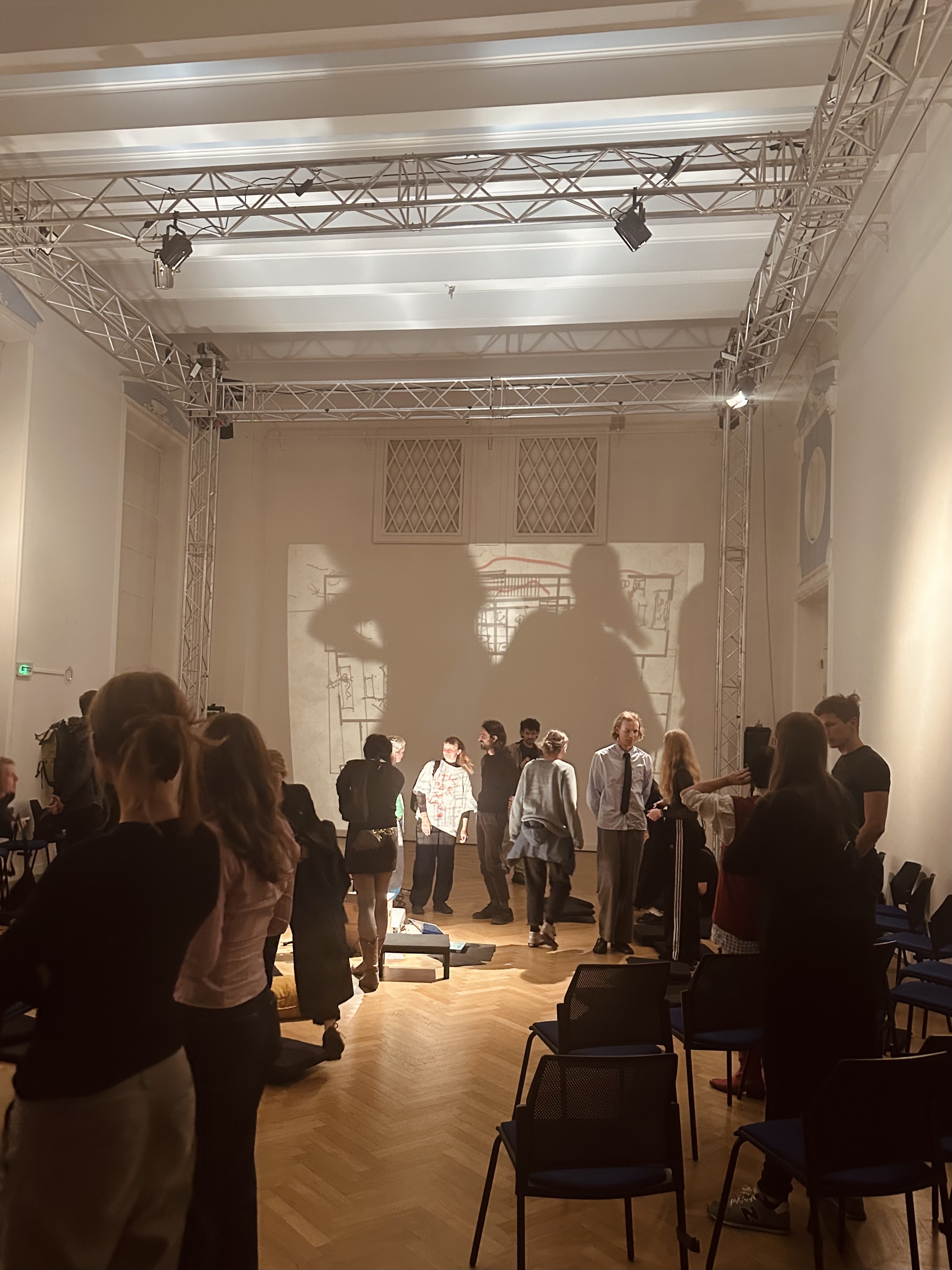
The challenge facing us in modernity is that the numerator is often larger than the denominator. That is to say, we place importance on things external to ourselves rather than being mindful that they are there to guide[1] us. This idea I put forward will be analysed with Ely Daou’s performance Cognitive Maps, Chapter I (SAAL Biennaal, Tallinn), in which the artist retraces his childhood homes floorplans and brings them to life through memory.
I reference Daou’s work as it embodies the formula of the self outlined above. Daou traces memories of his experience within his familial collective, relational encounters with the other, balanced with mindful presence within those memories. All of this culminates in an understanding of who Ely Daou is, what he has been through and the formative experiences that have shaped him. In this essay we will explore why I have chosen these particular variables and how Daou’s work embodies them.
The Variables
Our sense of self and identity emerges from the forces that allow us to describe who we are in the world. By naming the collective and other, I capture the essential external dimensions of identity: the shared frameworks that shape us (collective) and the relational mirrors through which we are seen (other). This, however, would remain incomplete without mindfulness, which safeguards the space for agency and individuality in the face of the collective and other. In this section we will delve more deeply into each variable.
The collective can be seen as social groups, norms, shared language, cultural traditions. Durkheim saw collective representations such as these to be structures that make individual thought possible. Whereby you become you inside a world that was already there, with people, rules and meanings. Freud’s account of the development of the self through childhood experiences helps expand this. For Freud, the self is structured through the negotiation of instinctual drives and the demands of authority, first in the family and then in wider society. Education and socialisation introduce limits and ideals that form the superego, creating both repression and the conditions for civilisation. In this sense, the collective not only protects but also shapes the psychic economy of the individual. To take this further, the collective can be seen as a socially derived framework that helps us, as individual selves, decide what thoughts, actions, responses and ways of conducting ourselves are rational in the context of our collective communities. Although, my equation of the self goes beyond Durkheim in the sense that it requires agency on our part, as mindfulness moderates the influence of collective. That is to say, the collective has rules and norms in place to protect us, and it is important we are mindful of this reality.
Lacan extends Freud’s insights by emphasising how the self is always mediated by the “Other.” The child’s entry into language and symbolic order, through parental speech and education, displaces the illusion of autonomy. Identity is not discovered within but reflected back from external images and words. In this way, socialisation and education are not additions to the self but constitutive of it, framing how one experiences both inner life and external relations. The other is all the things in this world external to the self such as relationships, items, ideas. For Lacan the other was a destabilising force because your sense of self is dependent on what is outside: where the self (ego) is mirrored, or born, by identifying with external images or under the use of language. The other is a significant aspect of modern life. There are many aspects of the world now that we attribute our sense of self – whether that might be a club, society or neighbourhood. These are mirrors, as Lacan outlines, of who we are. In a subtle way, we tie aspects of our identity to these parts of the world. However, if we attribute too much importance to these aspects of the world in identifying who we are, ourselves, then we lose ourself in a fragmented mirage of societally derived constructs. In the equation, the self frays when ideal images and external demands flood our sense of self.
The denominator in the formula is mindfulness. This is the practice of attentional presence that regulates the forces of collective and other. This regulating force derives agency by giving us the capacity to reflect on that which is external to ourselves. Kabat-Zinn secularises it as attentional regulation, being present in the moment – of which is very important when in the mode of reflection. Mindfulness, therefore, can be seen as a moderating force that allows us to balance the self in the face of the collective and the other. Heidegger presents authenticity as resoluteness – owning one’s existence against the pull of das Man[2]. The more mindful we are, the less influence the collective and the other has on our general sense of self. Without mindfulness, the pressures associated with the collective and the other multiply uncontrollably. With mindfulness, the self contextualises and puts these forces into perspective, integrating them without collapse wholly into the other or the collective. Therefore, through mindfulness, we can balance the collective and the other in order to achieve harmony within the self.
The relevance of this formula might be denied on the basis that it is reductive of the human experience. This is not the intention. The human condition, experience, is incredibly nuanced and is impossible to capture within a formula alone. What this formula intends to do is simplify the overarching aspects of our existence. Its value lies in clarifying the structural relations: collective and the other exert pressure. Mindfulness regulates. This formula offers a framework for analysis, not a reduction of a lived life. Daou’s performance demonstrates the model, illuminating each variable and how it builds into his sense of self through lived memory. But those memories are filled with emotions, experiences, and formative elements that cannot be captured in an equation.
Each variable is as important as each other. By framing selfhood in a structural formula such as the one above it challenges us to think differently: not as a static essence, but as a dynamic ratio. Allowing us to open dialogue across traditions without collapsing into any one framework. In the age of digital collectives and proliferating others the equation speaks to the risk of selfhood being overwhelmed by externalities. It also resonates with the lived experience, on the varying levels of mindfulness and the impact that this has on ourselves. In the next section, I will outline the work of Ely Daou and demonstrate exactly how mindfulness, when it is high, can anchor the self in sincerity, authenticity and wholeness.
Application: Matisse, Sorolla, Calder & Daou
To bring this equation to life, I will refer to the usage of space in art. Space is an invisible architecture. It is assumed, given and in my view miscredited. Yet it is precisely this ‘invisible visible’ of space that defines a work. Daou’s philosophy and live performance requires his viewers to live in reality, not in some perception of reality. This is what this performance is about, being mindful of the spaces we are in and being able to reconnect with our sense of self through the medium of space. The ‘Cognitive Maps’ is a mental mapping process that represents spatial information whereby we decode, recover, acquire and remember information based on our environment over time. In conjunction to this I reference the works of Matisse and Sorolla. Where these artists use the medium of paint on canvas, Matisse and Sorolla ask us to believe in another world through impressionism and realism whereas Daou asks us to attend this one.
Joaquín Sorolla – Rocks and Sea (early 20th century). Photo taken by author 2021. Museo Picasso, Málaga.
Henri Matisse – The Dance (1910). Photograph taken by author. Museum of Modern Art, New York City 2023.
We look at images such as the Matisse and Sorolla pieces above and we praise the illusion the artist creates. As if living inside of the illusion, the other, is more important than the world we occupy. Where an artwork is appreciated for its inward coherence rather than the relationship it has with our shared, collective environment. What I mean by this is that images are appreciated not for how they interact with our actual world, but for the world they create. In terms of self-formation, these works can stir emotion and awaken memory, but only indirectly: they confront us with a mediated image, not with ourselves. The illusion becomes a mirror, a way of reaching the self obliquely, rather than through mindful presence of the space we inhabit together.
If artists such as Matisse and Sorolla present us with the illusion of the other, Calder offers a different approach to space. One that is grounded in reality, offering presence. Calder inhabits space, time and colour. Three universal languages collaborating with our environment. Calder’s work with mobiles, suspended in the air, can be driven by wind flows through the room. These mobiles are dynamic and organic in the space they inhabit. The viewer’s movement around the room changes the perspective of the mobile and its various branches, actively engaging the viewer whilst it is in action. The mobile encodes a symbolic system of balance and negotiation – nothing is fixed, all is relational in the space we inhabit. Unlike the works of Matisse and Sorolla, Calder’s abstraction removes figuration, signalling transcendence, or even ascension, from the particularities of illusion toward universal harmony in our own reality.
Alexander Calder – Big Red (1959). Photograph by author, Whitney, New York City 2023.
Big Red refuses the ‘suspended reality’ of the picture plane, there is no other to contend with here, no inward world to enter. We are present within our shared collective environment. It is continuously unfolding within our shared reality – space, time and colour operating together to produce a living experience for the viewer. Calder’s mobiles don’t just occupy space as an image does. The mobiles move through it, collaborate with it, reminding us that art can live in both space, time and colour simultaneously.
Matisse & Sorolla’s illusions capture the other and Calder’s inhabitation of our collective reality begin to unravel a common thread. Space is not just a decorative addition, or a secondary element, it is the very pillar of any artwork that supports its overall foundation. Yet despite the differences between Matisse, Sorrolla and Calder, none of these works directly ground our sense of self. They are all abstracted from our own reality without much bearing on what grounds us – what it is that defines who we are, who we are becoming and where we have been. This is where the work of Daou’s performance, ‘Cognitive Maps, Chapter I’, steps in.
Ely Daou’s Equipment, Sakala 3 Teatrimaja, Tallinn, Estonia. Photo by author, 2025.
Ely Daou & audience. Sakala 3 Teatrimaja, Tallinn, Estonia. Photo by author, 2025.
By mapping out the spaces in which Daou lived throughout his childhood through floorplans, we trace back memories. His relationship with the other: cigarettes inside a bathroom, a picture of his grandfather on the wall. His participation within a collective: specific seats at the dinner table. The reliving of emotion: smoking on the balcony with his mother. His own personal history, room by room. Space by space. Daou inhabited the space physically, now, he brings space to life emotionally through memory. Daou’s use of space gently persuades the other, the collective and mindfulness through connection, relationship and emotion. All woven together through memory, reflection.
From my own experience with this performance, the viewer builds a relationship with Daou. Smiles and other reactions can be seen throughout the audience as his formative events unfold. His ability to transcend the physical, material world and into the immaterial, emotional world allowed his whole audience to build a relationship with him. Daou described the apartments through floorplans, the furniture in the rooms and the relationships he shared with family on occasions in those rooms. Daou’s art of being reflective on these experiences, his exploration of himself shows us how mindfulness can reconnect us with ourselves, with what is important to us and our relationship with the world around us.
For Daou, these recollections, however, are more than just memories. They hold a metaphysical arc as embodied memories that shape our collective sense making processes of who we are, who we become and how we interact with others (Mandalaki & Daou, 2021). By being more than a case of ‘what happened’ – these recollections serve as an active stance of remembering, reconstructing the self in relation to power structures, histories and more deeply, the worlds inequalities. Daou’s wider search for social justice, especially through the lens of feminism, invites questions not just about gender, but also about what it means to be human in this world (Mandalaki & Daou, 2021).
Through the performance of ‘Cognitive Maps’, I see the method Daou creates holds the space for marginalised identities to share stories, regain agency and challenge oppression. By this I mean memory work has the capacity to bring to life and clarify the structures in which we inhabit, the frameworks that map our lives. This is not a negative perspective but a liberating one. Memory, guided through architectural details in Daou’s performance, has the ability to bring to life the ‘invisible visible’ of space that is so characteristic of our existence. It has the ability to reveal identity making processes and how cultural, political, historical events shape us through the environments in which we live. Through the equation, memory work allows us to understand how our consciousness comes into being by understanding both the collective and the other through experiences that have shaped us and our psyches.
What matters most is these tools Daou has developed for self-reflection, self-understanding – mindfulness – allow us to understand his personality. Through the expression of his memories, the audience begin to understand Daou – we slowly begin to see him and the environment in which he was formed. Daou dissolves the distance between artist, art and his audience in a subtle and gentle way. The space we explored with Daou’s guidance is deeply personal. We are fortunate enough to have been shown what actually matters – connection, relationships, memory and the exploration of the self through the medium of space. An invisible that is impossible to ignore if we are mindful; an invisible that is now made entirely visible through Daou’s ‘Cognitive Maps: Chapter I’. A gift that allows us to connect, or reconnect, with our sense of self through the channels of the collective, the other through mindfulness.
Conclusion
The self cannot be conceived as an isolated essence but as a ratio of forces: collective, other, and the regulating work of mindfulness. To give primacy to any one variable is to encourage distortion. The value of this formula lies not in reducing the human condition to a simplified formula, but in clarifying the structural tensions that animate it.
Daou’s ‘Cognitive Maps: Chapter I’ demonstrate how this tension is lived. Memory locates him in the collective of family, the other of objects and relations, and the mindful act of retracing space. Daou’s performance resists illusion and abstraction: it grounds authenticity in presence. Art, therefore, becomes a testing ground for the formula of the self, where the fragile balance of forces can be made visible.
What follows is not a resolution but a point of notice. In an age of accelerated collectives and proliferating others, the danger is not merely the erosion of individuality but the challenge of maintaining presence. To understand this, the self must be shielded through mindful inhabitation of the world. Both Freud and Lacan remind us that the self is not a natural given but a product of formative encounters—with caregivers, with language, with institutions of learning and culture. These experiences, mediated through socialisation and education, anchor the individual in shared structures while also risking fragmentation. Mindfulness, in this sense, does not erase these variables but offers a way of inhabiting them reflectively. This formula is not an answer, but a guide, reminding us that authenticity is less about escaping the world through the collective or other but more about inhabiting it fully – together.
References
· Matisse, H. (1910)The Dance. Museum of Modern Art, New York City. Photograph by author, 2023.
Sorolla, J. (early 20th century)Rocks and Sea. Museo Picasso, Málaga. Photograph by author, 2021.
Calder, A. (1959) Big Red. Whitney Museum of American Art, New York.
Daou, E. (2023–25) Cognitive Maps, Chapter I. Performance at SAAL Biennaal, Tallinn.
Durkheim, É. (1912) The Elementary Forms of Religious Life. Paris: Alcan. [English trans. 1995, New York: Free Press].
Freud, S. (1923) The Ego and the Id. Standard Edition, Vol. 19. London: Hogarth Press.
Freud, S. (1930) Civilization and Its Discontents. Standard Edition, Vol. 21. London: Hogarth Press.
Heidegger, M. (1927) Being and Time. Tübingen: Niemeyer. [English trans. 1962, Oxford: Blackwell].
Judd, Donald. Donald Judd: Complete Writings 1959–1975. New York: New York University Press, 1975.
Kabat-Zinn, J. (1990) Full Catastrophe Living: Using the Wisdom of Your Body and Mind to Face Stress, Pain, and Illness. New York: Delacorte.
Lacan, J. (1949) ‘The Mirror Stage as Formative of the Function of the I’, in Écrits. Paris: Seuil. [English trans. 2006, London: W.W. Norton].
Lacan, J. (1977) The Four Fundamental Concepts of Psychoanalysis. London: Penguin.
Mandalaki, E., & Daou, E. (2021). Writing memory work through artistic intersections. Unplugged. Gender, Work & Organization, 28(5), 1912–1925. https://doi.org/10.1111/gwao.12720
[1] Help, assist, provide context to our relations with each other. A framework of mutual understanding.
[2] No negative connotations of the utilisation of ‘das Man’ are meant in this essay.
One of the greatest challenges we face in modernity is clarifying what truly underpins happiness. Competing traditions define it in different ways, yet a balanced account understands happiness as a state of well-being that arises when core needs are sufficiently met, desires are moderated with mindfulness, and life is experienced with a sense of meaning, balance and fulfilment (Diener 1984, Diener & Seligman 2004, Ryan & Deci 2000, Sen 1999, Kabat-Zinn 1990, Brown & Ryan 2003). The difficulty, however, lies in the sheer noise of contemporary life: endless things to buy, places to visit, people to meet, goals to pursue. These demands move in conjunction with one another and present themselves as natural or inevitable – or, to borrow Marx’s (1867) term, reified. Yet many of the things we chase today may be better understood not as timeless human needs but as socially manufactured wants, constructs that have emerged largely within the last century (Veblen 1899, Galbraith 1958, Marcuse 1964, Baudrillard 1970, Bauman 2007). The blurring of lines between needs and wants has made happiness increasingly elusive, demanding careful reflection on how we navigate comfort, consumption and meaning in our lives.
A common frustration in the human condition today may stem from our tendency to blur the line between wants and needs (Veblen 1899, Galbraith 1958, Marcuse 1964, Bauman 1998, 2007). In doing so, we institutionalise socially manufactured desires, elevating them to the status of necessities despite their lack of connection to our core human requirements of survival, esteem, or self-actualisation. The noise of contemporary life amplifies this confusion, making it increasingly difficult to discern what we truly require from what we are merely conditioned to crave. These manufactured wants are persuasive precisely because they promise social acceptance, respect and recognition – markers of worth in the collective (Veblen 1899, Marcuse 1964, Bauman 1998 & 2007, Baudrillard 1970).
This malignment generates profound challenges, and the culmination of these challenges finds vivid expression in Cy Twombly’s Bacchus series. Through the figure of a Roman god synonymous with excess, Twombly captures the passion, frenzy and aggression that erupt when wants overwhelm needs. Maslow reminds us that “man is a perpetually wanting animal” and the consequences of this condition are inscribed in the raw, graphic nature of Twombly’s canvases, where the fine line between adequately met needs and excessive wants collapses into a violent pursuit. The association of Bacchus with both Roman and Greek traditions also invites a deeper question: is this unrelenting drive toward excess a fundamental part of human nature, and if so, can it be harnessed for our betterment rather than our detriment?
The primary dimension of this challenge lies in the very nature of happiness itself. Happiness is not a singular or uniform experience; it varies from person to person and expresses itself in many different ways. What brings one individual contentment may leave another unfulfilled. Yet modern life often obscures this reality: we are constantly shown, and sold, the things that supposedly make others happy. Lacking any true anchoring in our own needs, we pursue these borrowed markers of happiness in the hope they will fulfil us as well. More often than not, however, this pursuit ends in emptiness or dissatisfaction. We confuse the satisfaction and acceptance we see in others with what is genuinely right for ourselves. Despite these variations, I believe there exists a shared foundation – a universal meta-structure of variables that underpins happiness for us all. I have built an analytical framework that allows us to see happiness not as a random or purely subjective phenomenon, but as a pattern shaped by prevalent human conditions, even as each of us fills the details differently. This framework is the result of my own personal experience with happiness and should not be considered a guarantee to being happy, nor is it representative of other people’s happiness.
To better understand what truly drives happiness, I propose three core forces at play: needs, wants and mindfulness. These variables shape not only our sense of fulfilment but also much of the dissatisfaction characteristic of modern life. If we are to move forward – to confront directly what makes us happy and what corrodes that happiness – we must first establish a clear understanding of these forces and how they interact with one another. To illustrate this tension between needs, wants and mindfulness I have constructed a diagram mapping the relationship between consumption and happiness. As shown, the satisfaction of basic physiological needs initially increases happiness, represented by the upward slope of the curve. Beyond this threshold, further consumption continues to contribute to wellbeing until it reaches a peak, denoted as C*, the point of optimal balance between needs and wants. However, once consumption surpasses this point, happiness begins to decline. The downward trajectory represents the corrosive effect of institutionalising wants as needs – where excess consumption not only fails to deliver greater fulfilment but actively undermines it. In what follows, I will examine each of these variables in turn — needs, wants, and mindfulness — to demonstrate how their interaction defines the conditions of happiness, and how their misalignment is powerfully expressed in Twombly’s Bacchus series.
Equation
Happiness = (Needs x (1 + Mindfulness)) / (Wants x (1 – Mindfulness))
*Note, this equation is structural not mathematical. This equation is not a reduction of the lived experience but an analytical framework for the purpose of this essay.
Diagram
*Note, consumption within the graph has a flexible definition. I do not mean consumption in the strict sense of purchasing goods or services, but consumption of aspects of the world that contribute to the satisfaction of needs/desires within the hierarchy of needs.
Variables
For the definition of needs, I adopt Maslow’s hierarchy. At the base lie physiological needs – food, water, sleep – followed by safety needs such as housing, income and protection from danger. Beyond these, more complex needs emerge such as love and belonging through family, friendship, intimacy and community; then esteem through recognition and being respected; finally, self-actualisation through personal growth, purpose and authenticity. The initial needs associated with survival can be understood as consumption at the threshold where physiological needs intersect with the happiness curve. These survival needs take precedence, but once they are satisfied, we ascend the hierarchy toward higher-order needs culminating in self-actualisation. This progression occupies the region of the curve between the fulfilment of physiological needs and the optimal point C*.
It is important to clarify that happiness here is not derived from consumption in the narrow sense of purchasing goods, but rather from the broader consumption of the world’s resources, relationships and opportunities necessary to satisfy the hierarchy of needs. This is because higher-order needs often resist material fulfilment whereas lower needs within the hierarchy are satisfied through goods and services (food, housing). Within the structural equation, the more needs we meet, the greater our happiness becomes, since increasing the numerator – needs – raises the overall value of happiness, all else being equal.
One way to think about a want is as a chosen means of attempting to satisfy a given need. While the need is the end goal, the want is the chosen method or expression of desire through which we attempt to meet that goal. Needs are universal across cultures, but wants are shaped by personal preferences, cultural contexts, and situational factors. Unlike needs, which have natural limits, wants are open-ended and can proliferate without clear boundaries. In the structural equation, holding circumstances constant, an increase in wants enlarges the denominator, thereby reducing overall happiness. Diagrammatically, this dynamic is captured in the downward slope of the curve beyond C*, where the pursuit of excessive wants leads to diminishing returns. This cycle is often described as the hedonic treadmill (Brickman & Campbell 1971): each new want offers a temporary uplift before resetting the baseline of happiness, prompting yet more striving without lasting fulfilment. It is important to note that wants are not inherently negative. They add colour, variety, and individuality to life. The problem arises when wants overshadow or replace needs – especially beyond C* – where they cease to enrich wellbeing and instead corrode it.
Modern economies and advertising intensify this problem by manufacturing wants and blurring the distinction between genuine need satisfaction and socially conditioned desires (Veblen 1899, Galbraith 1958, Marcuse 1964, Bauman 2007, Baudrillard 1970). This process results in the institutionalisation of wants as needs, where socially constructed desires are elevated to the status of essentials. A second dimension of this condition is comparison and competition: socially derived constructs come to be viewed as fundamental necessities for respected inclusion, acceptance, and participation in the collective (Marwick 2013, Twenge 2017). The expansion of wants therefore traps individuals of cycles of consumption, generating instability in happiness that is vulnerable not only to novelty-seeking and social pressures but also to the corrosive comparisons that modernity continually fosters. Yet this cycle is not confined to the accumulation of goods and services. It can equally be driven by the pursuit of experiences, friendships, or other markers of meaning that, while appearing to satisfy higher needs, may still bypass the underlying foundations of security, belonging, and sufficiency. In such cases, the search for fulfilment risks becoming another restless chase, where even relationships and experiences are consumed in the same spirit as commodities.
Mindfulness can act as a moderating force, helping to balance wants with the satisfaction of needs (Kabat-Zinn 1990, Brown & Ryan 2003, Ryan & Deci 2000). As Kabat-Zinn (1990) argues, mindfulness is a discipline of paying attention to the present moment with intentionality and acceptance, a practice that interrupts the cycles of craving and reorients us toward balance and sufficiency. It scales down the pressure of cravings, comparison, and what is described as the ‘fear of missing out’. In terms of the structural equation, mindfulness reduces the urgency of wants by helping us see simpler and more sustainable ways of meeting underlying needs, thereby shrinking the denominator. At the same time, mindfulness deepens our appreciation of needs that are already met – presence and gratitude make these satisfactions feel fuller, raising the numerator without altering external circumstances.
Practicing mindfulness may reduce the level of consumption we feel is necessary to experience contentment. It keeps us within the healthy range of the curve, between the fulfilment of physiological needs and the optimal point C*, rather than sliding down into the corrosive region of overconsumption. Mindfulness enriches the experience of needs by preventing wants from being mistaken as necessities. In this way, it creates a balance between sufficiency and restraint, shifting the focus of happiness from external fulfilment to internal calibration. By cultivating awareness and presence, mindfulness interrupts the cycle of ever-escalating wants and resets satisfaction at a more sustainable baseline. It reorients markers of success away from external symbols such as possessions and status, and toward internal ones such as meaning, relationships and authenticity. Anchoring us in the present, mindfulness reduces both anxiety about future desires and regret about unmet ones, thereby stabilising happiness over time.
Ultimately, mindfulness makes happiness less dependent on material conditions. Even modest levels of fulfilment can feel abundant when attended to with gratitude. In contrast, unhappiness often stems from mistaking wants for needs; mindfulness sharpens our perception, clarifying which satisfactions are genuine and which are distractions. In consumer-driven societies especially, mindfulness offers resistance against the relentless stimulation of wants through media and social comparison, ensuring that happiness remains grounded in proportion and presence rather than excess.
Yet this progression through the hierarchy is neither fixed nor linear (Maslow 1954, Koltko-Rivera 2006, Deci & Ryan 2000, Tedeschi & Calhoun 2004). Life regularly unsettles its trajectory, particularly in moments of grief or illness. When such afflictions take hold, the pursuit of esteem or self-actualisation recedes, and the priority shifts decisively back toward the alleviation of sufferation and the restoration of basic stability. In these moments, our most fundamental needs – food, rest, safety and above all the support of others – reassert themselves as paramount. Relationships, ordinarily understood as part of belonging or esteem, reveal their deeper role as a foundation of physiological and safety needs. When these are fractured or threatened, the entire structure of our priorities is reordered. Other aspirations do not disappear, but they are placed in abeyance until the more urgent demands of recovery and resilience are met.
There is also the challenge of circumstance. The role of want satisfaction as a factor in shaping happiness is deeply contingent on context (Maslow 1954, Sen 1999, Tay & Diener 2011, Inglehart & Welzel 2005, Diener & Seligman 2004). The dynamics of consumption and fulfilment in wealthy Western democracies differ profoundly from those regions marked by scarcity or instability. In this sense, the equation remains valid, but its interpretation shifts with the conditions upon which it rests. The means by which needs are satisfied are not universal, but situational – shaped by cultural, economic and political environments. When confronted with different structural realities such as inequality, poverty or systemic challenges, the trajectory through Maslow’s hierarchy is fundamentally altered. In such contexts, survival displaces purpose, and the pursuit of self-actualisation yields to immediate necessity of securing food, shelter and safety. These needs are equally fundamental. There is no secure basis upon which to judge or measure happiness, nor is there an ability to create a scoring system that ranks one person’s happiness above another depending on their satisfactions at different levels of the hierarchy.
That is to say happiness cannot be reduced to a hierarchy of worth, but instead must be understood as a shifting balance, where each tier of need is vital in its own right (Maslow 1954, Tay & Diener 2011). The satisfaction of higher-order needs such as self-actualisation does not guarantee a greater degree of happiness than the fulfilment of physiological or safety needs. One individual engaged in self-actualisation may not be ‘happier’ than another whose efforts are directed toward survival. Each tier carries its own weight and significance, and happiness arises not from comparison across levels but from the sufficiency of needs being met within the context of one’s lived circumstances.
A final challenge concerns the promises attached to specific wants within the context of social groups (Bauman 2007, Zuboff 2019, Turkle 2011, Twenge 2017, Marwick 2013). The rise of social media and similar platforms has intensified comparison, introducing new obstacles to gratitude, mindfulness, and appreciation of one’s circumstances relative to others. These platforms accelerate the institutionalisation of wants by elevating socially manufactured desires into apparent necessities, compounding the tension between superficial aspiration and underlying need. The result is a new level of competition that generates systemic pressures on wellbeing, eroding happiness on an unprecedented scale and speed.
Taken together, these three variables – needs, wants, and mindfulness – provide a structural lens through which to understand the conditions of happiness and its erosion. When needs are sufficiently met and moderated by mindfulness, happiness is stabilised. When wants proliferate unchecked, particularly when they are institutionalised as needs, the balance collapses and wellbeing deteriorates. This tension between adequacy and excess is not only theoretical but vividly embodied in art. Cy Twombly’s Bacchus series offers a powerful visual metaphor of the cycles of craving, frenzy and decline that emerge when wants overwhelm or overpower needs and mindfulness is absent. In the following section, I turn to Twombly’s work to explore how these psychological dynamics are dramatized on canvas.
Application: Cy Twombly Bacchus
Cy Twombly – Bacchus, Tate Modern. Photograph taken by author, 2022.
Referencing Maslow’s magnum opus with the claim “man is a perpetually wanting animal” highlights a central challenge of human nature: our desires are endless (Maslow 1954). Twombly vividly brings the troubles of this reality to life. This series takes its namesake from Roman mythology with Bacchus symbolising a profound truth about human psychology – that we are irresistibly drawn to indulgence and transgression (Otto 1965, Seaford 2006, Dodds 1951). Synonymous with the vine and wine consumption, wine becomes an emblem of this condition. It loosens and inspires us; offering joy and creativity, yet it just as easily overwhelms us when taken too far.
The mythology surrounding Bacchus illustrates the dangers of mistaking fleeting pleasures for lasting fulfilment, where wants, seductive in their immediacy, become corrosive when confused with core needs. Bacchus dramatizes how quickly joy, play, and release can tip into frenzy – how the pursuit of pleasure, if left unmoderated, can spiral into destruction – the hedonic treadmill that we discussed past the point of C* on the diagram above. Bacchus’ very essence embodies the precarious crossing of the line between balance and excess, restraint and abandon (Otto 1965, Dodds 1951, Seaford 2006, Burkert 1985). In this sense, Bacchus symbolises the enduring human temptation to surrender fully to passion, pleasure or madness, even at the cost of stability and wellbeing.
Bacchus, then, may be read as a mythological dramatization that resonates with the dynamics expressed in my framework. His intoxicating force embodies the danger of wants mistaken for needs, where fleeting desires are elevated into supposed essentials. While needs, in Maslow’s sense, are finite and stabilising, the wants associated with Bacchus are endless, seductive, and corrosive when pursued without limit. The absence of mindfulness is what allows this spiral to take hold, collapsing restraint and tipping joy into frenzy. In this way, Bacchus mirrors the structural equation of happiness: as wants proliferate unchecked, mindfulness recedes, balance gives way to excess and fulfilment erodes.
Cy Twombly’s Bacchus series captures this collapse on canvas, his looping, aggressive brush enacting the very cycles of desire, abandon and decline that Bacchus symbolises. The large circular forms dominate the surface with a restless energy, cycling endlessly yet arriving nowhere. A visual theatre of pain, struggle and suffering dominates, the visual representation of the hedonic treadmill. Where the pursuit of ever-expanding wants delivers no lasting fulfilment. These gestures mimic the futile attempt to recapture the contentment once reached at point C* on the happiness curve, only to find diminishing or even corrosive returns.
The dripping paint suggests as lack of control, as though the artist were in a blind rage – satisfying wants without ever touching the underlying needs. This chaotic release could be seen as embodying the institutionalisation of wants as needs: socially manufactured desires mistaken for essentials and pursued with unrelenting intensity. The result many not elevation but descent, as happiness slides into dissatisfaction. Each desire, once attained, gives way to the next, and without mindfulness this restless pursuit becomes corrosive, turning the natural progression up the hierarchy into a chase that undermines the wellbeing it seeks to secure. This aggression, this sense of frenzy, may itself be symptomatic of the failure of promises to be fulfilled – the moment when socially manufactured wants reveal their emptiness, leaving frustration in place of fulfilment.
The chosen colour intensifies this effect. The electric red saturating the canvases connotes danger, violence and urgency, symbolising the aggression and exhaustion produced when consumption replaces contentment and striving displaces sufficiency. The synergy between Maslow’s claim that man is ‘perpetually wanting’ and Twombly’s visual dramatization, pointing toward a compelling interpretation. Regardless of social context – whether in wealthy democracies or regions of relative scarcity – the principle endures. Once survival needs are met, attention shifts to the next desire, the next aspiration, the next ‘best’ thing. This perpetual cycle, though natural, carries a corrosive potential, threatening the stability that need satisfaction is meant to secure.
The absence of mindfulness is crucial here. Nothing intervenes to break the cycles of brushstrokes, to pause the frenzy, to recalibrate balance between needs and wants. Instead, what we see is an inner maelstrom. The canvases culminate in a direct routing of raw emotion onto the surface without reflection or regulation. In this sense, Twombly’s Bacchus makes visible what happens when mindfulness is neglected: wants escalate, needs go unexamined, and happiness disintegrates into restless consumption. Mindfulness enables us to place the satisfaction of our desires and needs in proper context. It is through mindfulness that we recognise the reality of being ‘perpetually wanting’ while resisting the compulsions that flow from it. Returning to the question posed at the outset of this essay, it is mindfulness that allows us to moderate and contain desire, transforming an endless chase into a source of balance and, ultimately betterment.
Had mindfulness entered the process, the circular strokes might have broken, opened or paused – introducing proportion, restraint, and even silence. Its absence, however, enacts the misalignment of means and ends, where the pursuit of pleasure collapses into excess and the promise of fulfilment dissolves into agitation. Twombly’s paintings thus dramatize, at room scale, the psychological truth that happiness requires the mindful regulation of wants in the service of needs; without such balance, passion tips inevitably into frenzy.
It is this unrelenting frenzy that fuels dissatisfaction within the natural progression up the hierarchy of needs. The satisfaction of higher-order aspirations does not necessarily yield greater happiness than the fulfilment of basic survival needs. Yet modernity – through mass media, advertising and the manufacture of socially derived desires – has obscured this truth, distorting our understanding of what genuinely sustains both contentment and fulfilment.
I remember standing before these canvases and being overcome with emotion. They stirred memories of difficult experiences in my own life – moments of fear and violence, such as witnessing the shooting of a jewellery store guard, alongside other struggles that surfaced from the depths of memory. The encounter became a harrowing ordeal of recollection, as toxic memories pressed against the surface of consciousness. In this sense, the canvases did not merely present abstraction; they embodied the culmination of struggle bound up with the human condition, illuminating the severity and violence that can accompany the challenges of meeting both our basic and more complex needs in society today. What struck me most was how these struggles reflected profound truths about what people are willing to do to one another in order to secure survival or to achieve their own state of ‘happiness’ or ‘contentment’ – often at the expense of others’ wellbeing. The risks people take to secure something for themselves highlight the fragility and volatility of human desire when it is left unchecked. Here, the role of mindfulness becomes critical: it moderates wants and desires in the service of genuine needs, reminding us that life is not zero-sum but a series of trade-offs that demand balance, perspective and restraint.
Conclusion
Happiness cannot be reduced to consumption, nor can it be ranked by a hierarchy that privileges some needs over others. As Maslow and his interpreters remind us, life continually unsettles our priorities: grief, illness, and differing contexts shift our trajectories, showing that survival, safety, belonging, esteem and self-actualisation are all fundamental in their own right. Modernity complicates this further by manufacturing wants and presenting them as needs, trapping us in the hedonic treadmill where fulfilment dissolves into restless striving.
Mindfulness can be seen as a corrective force. It interrupts the escalation of wants, deepens appreciation of already met needs, and restores proportion to the pursuit of fulfilment. In Kabat-Zinn’s sense, mindfulness grounds us in the present moment, cultivating gratitude and sufficiency even within modest conditions. It transforms happiness from a chase after novelty into a practice of balance and presence.
Twombly’s Bacchus series makes this dynamic visible. His violent loops and searing reds dramatize what happens when mindfulness is absent: wants spiral into frenzy, joy collapses into excess and balance is lost to chaos. Yet embedded in these canvases is also a latent possibility – that the cycles of passion might pause, open, and reform if tempered by reflection and restraint.
When I stood before these canvases, I was overcome with memories of fear and violence – moments of witnessing suffering including the shooting of a jewellery store guard. These paintings become more than abstraction: they embodied the struggles bound up with the human condition, the severity and violence that can arise when people pursue survival or happiness at the expense of others. They suggest that unchecked desire can be corrosive to personal wellbeing and may also undermine our shared humanity. Here, mindfulness is crucial – it allows us to see that life is not a zero-sum game, but a series of trade-offs requiring balance, restraint, and perspective.
One way to think about the pursuit of happiness is not as abolishing desire but as calibrating it. It requires meeting needs sufficiently, choosing wants proportionately, and cultivating the mindfulness to hold both in balance. In this equilibrium lies the possibility of a happiness that endures – not fleeting or corrosive, but grounded in what is essential, meaningful and sustainable.
References
Baudrillard, J. (1970). The Consumer Society: Myths and Structures. London: Sage.
Bauman, Z. (1998). Work, Consumerism and the New Poor. Buckingham: Open University Press.
Bauman, Z. (2007). Consuming Life. Cambridge: Polity Press.
Brickman, P. and Campbell, D.T. (1971). Hedonic relativism and planning the good society. In: M.H. Appley (ed.) Adaptation-Level Theory: A Symposium. New York: Academic Press, pp.287–302.
Brown, K.W. and Ryan, R.M. (2003). The benefits of being present: Mindfulness and its role in psychological well-being. Journal of Personality and Social Psychology, 84(4), pp.822–848.
Burkert, W. (1985). Greek Religion: Archaic and Classical. Cambridge, MA: Harvard University Press.
Deci, E.L. and Ryan, R.M. (2000). The “what” and “why” of goal pursuits: Human needs and the self-determination of behavior. Psychological Inquiry, 11(4), pp.227–268.
Diener, E. (1984). Subjective well-being. Psychological Bulletin, 95(3), pp.542–575.
Diener, E. and Seligman, M.E.P. (2004). Beyond money: Toward an economy of well-being. Psychological Science in the Public Interest, 5(1), pp.1–31.
Dodds, E.R. (1951). The Greeks and the Irrational. Berkeley: University of California Press.
Galbraith, J.K. (1958). The Affluent Society. Boston: Houghton Mifflin.
Inglehart, R. and Welzel, C. (2005). Modernization, Cultural Change, and Democracy: The Human Development Sequence. Cambridge: Cambridge University Press.
Kabat-Zinn, J. (1990). Full Catastrophe Living: Using the Wisdom of Your Body and Mind to Face Stress, Pain, and Illness. New York: Delacorte.
Koltko-Rivera, M.E. (2006). Rediscovering the later version of Maslow’s hierarchy of needs: Self-transcendence and opportunities for theory, research, and unification. Review of General Psychology, 10(4), pp.302–317.
Marcuse, H. (1964). One-Dimensional Man: Studies in the Ideology of Advanced Industrial Society. Boston: Beacon Press.
Marwick, A.E. (2013). Status Update: Celebrity, Publicity, and Branding in the Social Media Age. New Haven: Yale University Press.
Marx, K. (1867). Capital: Critique of Political Economy. Volume I. Hamburg: Otto Meissner Verlag.
Maslow, A.H. (1943). A theory of human motivation. Psychological Review, 50(4), pp.370–396.
Maslow, A.H. (1954). Motivation and Personality. New York: Harper & Row.
Otto, W.F. (1965). Dionysus: Myth and Cult. Bloomington: Indiana University Press.
Ryan, R.M. and Deci, E.L. (2000). Self-determination theory and the facilitation of intrinsic motivation, social development, and well-being. American Psychologist, 55(1), pp.68–78.
Seaford, R. (2006). Dionysos. London: Routledge.
Sen, A. (1999). Development as Freedom. New York: Alfred A. Knopf.
Shapiro, S.L., Carlson, L.E., Astin, J.A. and Freedman, B. (2006). Mechanisms of mindfulness. Journal of Clinical Psychology, 62(3), pp.373–386.
Tay, L. and Diener, E. (2011). Needs and subjective well-being around the world. Journal of Personality and Social Psychology, 101(2), pp.354–365.
Tedeschi, R.G. and Calhoun, L.G. (2004). Posttraumatic growth: Conceptual foundations and empirical evidence. Psychological Inquiry, 15(1), pp.1–18.
Turkle, S. (2011). Alone Together: Why We Expect More from Technology and Less from Each Other. New York: Basic Books.
Twenge, J.M. (2017). iGen: Why Today’s Super-Connected Kids Are Growing Up Less Rebellious, More Tolerant, Less Happy – and Completely Unprepared for Adulthood. New York: Atria Books.
Twombly, C. (2005). Bacchus [Painting series]. Tate Modern, London.
Veblen, T. (1899). The Theory of the Leisure Class: An Economic Study of Institutions. New York: Macmillan.
Zuboff, S. (2019). The Age of Surveillance Capitalism: The Fight for a Human Future at the New Frontier of Power. New York: PublicAffairs.
Rothko’s Seagram Murals are a rejection of the institutions that birthed them. Their scale, colour and architecture produce durational feedback that echoes long after you have viewed them. A sigh, conviction and altered mood are expected. What the viewer is presented with isn’t a window, but a mirror – a tarnished one at that. Within this room, what is mirrored is a certain finality. A finality that makes you look inward.
Both light and sound throughout the room is absorbed. The edges bleed into one another. Tones of blood, dried. Shades of coal, purple culminate in aftermath, spent energy and bruising. The colours, alongside the scale, create a silence. A silence that isn’t just heard but seen. Rothko brings the quiet of this room into being. As if you are walking into a confessional chamber. What these works conjure up is what the viewer carries with them into the room. The finality here is the sense that it is just you in the room and that you are alone. No beauty or inspiration takes hold. This is a room for contemplation.
These pieces were commissioned for an elite dining room. Yet what we see here are sarcophagus-like shapes that dominate the canvases. Painted tombstones. These pieces would not complement a diner’s experience. Diners would be digesting their own emotions, preoccupations, mental states in front of these paintings. This was Rothko’s intention.
The murals are a rejection of the idea that scale, luxury and productivity yield meaning within our lives. Rothko outwardly contests the economic and patronage institutions that commissioned them. These institutions value display, performance, visibility. Rothko sees the tragic failure of this kind of spectacle to satisfy the psyche, bringing this idea to canvas. Instead of comforting the diners, these pieces reassert inwardness. The material realm does not hold the answers. The answers, according to these paintings, are contained within.
What strikes me most about these works is the alienation, the anomie that submerges the viewer. These pieces negate our surroundings. The combination of form and colour creates a finality of presence through this negation. It is this void that the grandeur of modernity tries to conceal. For Rothko, only interior truths can face the dilemma of our estrangement and alienation. These works, displayed together, provide the medium to achieve that.
The Seagram Murals highlight the value Rothko placed on the deeper, more meaningful questions. The kind of questions that confront us. That is what the viewer is made to reconcile when faced with these canvases: Who are you?
Disclaimer
Everything written here is my own reflection — imperfect, interpretive, and open to disagreement. Nothing is meant to offend or exclude anyone. Art invites feeling and thought in equal measure; what’s offered here is simply one person’s encounter with it.
References
Ashton, Dore. About Rothko. Oxford University Press, 1983.
Fischer, John. “Conversations with Rothko.” Harper’s Magazine, Nov. 1959.
Morley, Simon. Writing on the Wall: Word and Image in Modern Art. Thames & Hudson, 2003.
O’Doherty, Brian. Inside the White Cube: The Ideology of the Gallery Space. University of California Press, 1976.
Rothko, Mark. The Artist’s Reality: Philosophies of Art. Edited by Christopher Rothko, Yale University Press, 2004.
Rodman, Selden. Conversations with Artists. Capricorn Books, 1961.
Sandler, Irving. The Triumph of American Painting: A History of Abstract Expressionism. Harper & Row, 1970.
Tate Modern. Mark Rothko: The Seagram Murals. Exhibition Catalogue, Tate Publishing, 2008.