There is no right way to look at a work of art nor is there are correct way to interpret art, this I will admit. By the nature of their genius, artists are anomalous and the work they produce is no different. Art is a dynamic and individualised experience.
Behind every artwork, however, is a specific intention, philosophy and metaphysical reality developed by the artist. Art works are not born into a vacuum. They enter into a symbolic order that is already there. Part of understanding works of art is to understand how they fit into that bigger picture alongside the artist that produced them. This is the macro and micro working together, or in some cases, working against each other. Ultimately, these components are absorbed within the medium to communicate something to you, the viewer.
The message can be unclear, difficult to decode. Worse still, surrounded by art-speak. In response, I have developed this framework as a method for analysing and criticising artworks. This is my own personal approach to understanding what an artist is trying to communicate through their work.
This is a framework of interpretation. It is not an answer, but an attempt at a solution for deciphering what a work of art is communicating. Below you will find a summary of the variables and how they gel together to form a coherent narrative behind artistic production.
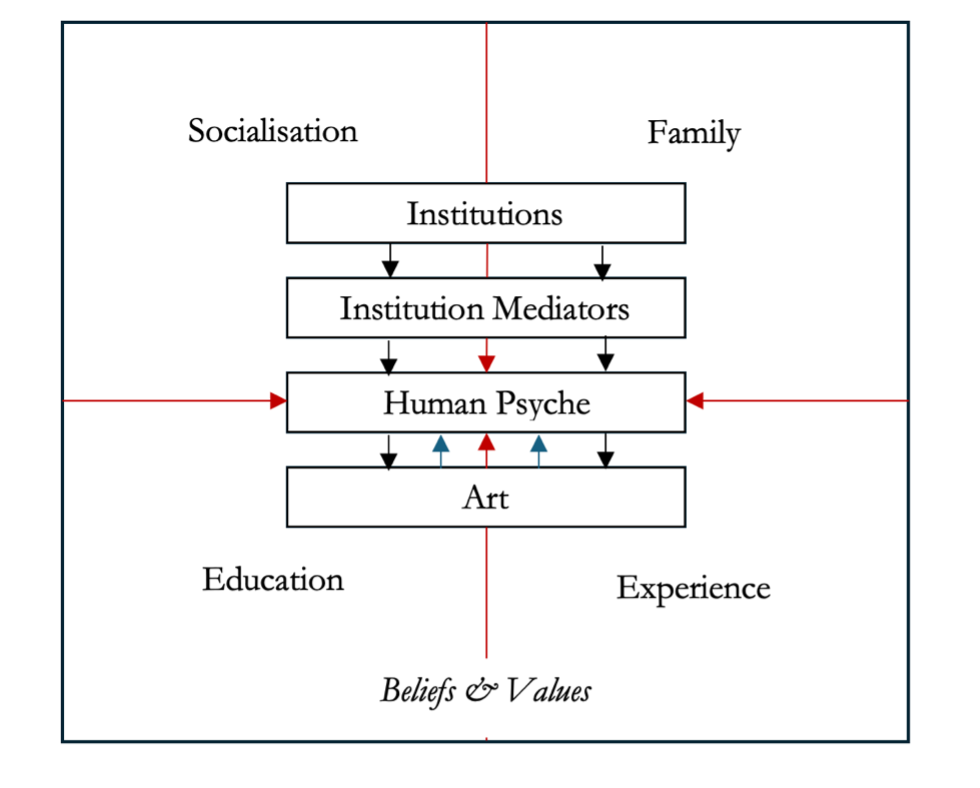
This framework rests on a definition of what art, at its most fundamental level, is. When considering art’s origination, the source of art, I define art to be the expression of consciousness. Where expression is the externalisation of an internal world of thought and feeling. Consciousness isn’t a free floating faculty, but the product of a specific architecture; one that can be defined as the cross section between an individual’s formative experience alongside an artist’s existence within a symbolic order, a social order. Thus art, as the expression of consciousness, is the crystallisation of the individual and the social.
The Psychic Economy of the Artist
The individual’s psychic economy is made up of the variables outlined within the diagram above. This is the architecture of consciousness where individual formative experience meets with social experience. Ultimately, all of these variables combine together to inform and lay the foundations for an individual belief and value formation.
Experience
This isn’t just about what happens to a person, but what is metabolised as a result – what leaves a residue on their perception and emotional repertoire. Their way of encountering the world. This variable is what creates the basis of differentiation between artists, and people more generally. It shapes their perceptual and affective structures through which material is processed and expressed. Experience is not just a constraint on behaviour, but its very substance.
Education
Education provides a scaffolding surrounding how we structure the world; frameworks onto which to navigate the world. This process is how we acquire categorisations and distinctions through which all of our experiences are organised. Education provides a field in which to structure artistic production, providing the substrate that supplies meaning to work. Education, therefore, is multi-dimensional – it provides not only the tools, but also the possibility to develop a personal and individualised position.
Family
This is the earliest variable of human development. Where primary emotional dispositions are established, where aesthetic preferences are shaped, initial orientations towards looking – making and valuation are formed. Family creates tastes, habits of mind, frameworks of value that further build into the production of an individualised position.
Socialisation
This the ongoing process through which an individual is constituted as a social being. The constant process, negotiation, between the individual psyche and the social world that shapes identity, values and orientation over time.
Together these four dimensions constitute the psychic economy of the individual. This is irreducibly individual, but is never purely individual; at every point it bears the imprint of social conditions.
The institutional dimension
The psychic economy does not operate within a vacuum. It operates within a structured social space that shapes the conditions of artistic production, frames questions where artistic expression is a response and provides criteria by which values are educated and significance determined.
Institutions
At their most fundamental level, institutions are constraints on human behaviour; divisible social structures that organise and regulate human activity. In the context of artistic production this includes institutions such as galleries, museums, academies, education establishments, government and law. What unifies all of these institutional apparatus is the imposition of a framework, or logic of appropriate action, within which artistic value is constituted and contested.
Institutional Mediators
These constitutes the immediate social environment in which institutions manifest. Mediators are not conduits between artist and institution. They are the agents through which institutional frameworks are managed, reproduced – transformed. Where criterions of value are negotiated, contested, revised. For the art market, these are critics, curators, dealers, collectors and educators.