Category: Uncategorized

  • George Rouy – Reprise: Hannah Barry Gallery, London

    George Rouy – Reprise: Hannah Barry Gallery, London

    “The river

    Where you set 

    Your foot just now

    Is gone – 

    Those waters

    Giving way to this, 

    Now this.”

    – Heraclitus
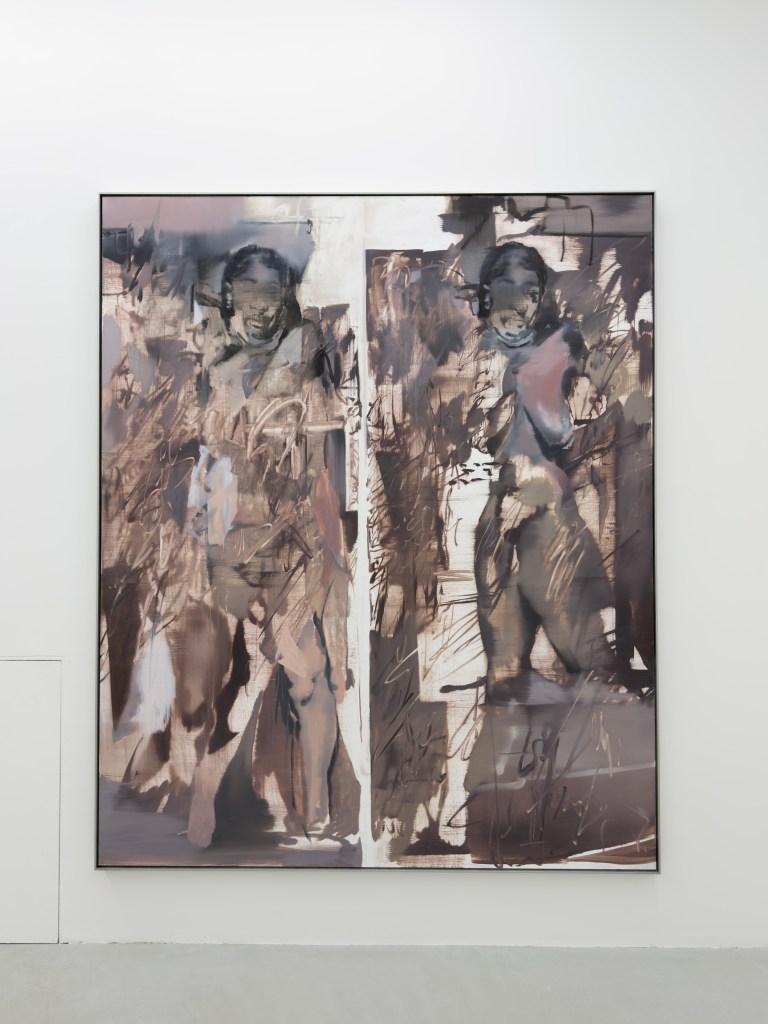
    George Rouy, REPRISE, 2026

    Oil on canvas 

    230.3 x 190.2 x 4.2cm 
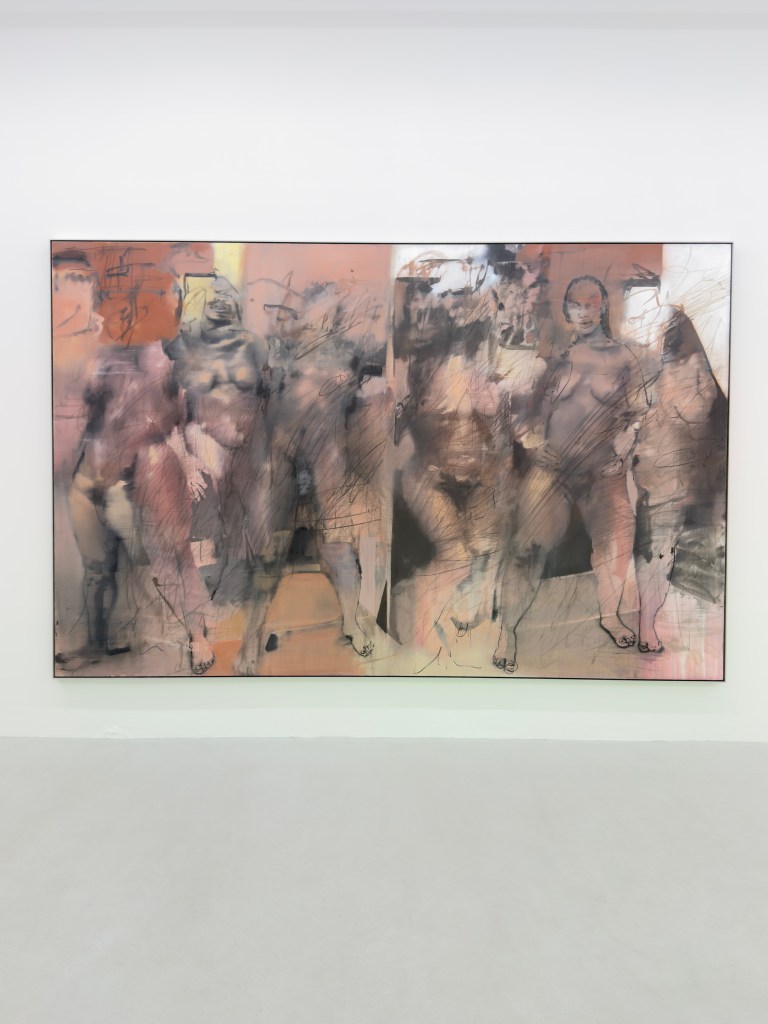
    George Rouy, The Split, 2026

    Acrylic and charcoal on canvas 

    220 x 340.2 x 5cm 

    In 1897 Paul Gauguin asked the questions “where do we come from? What are we? Where are we going?”. Gauguin’s work answered none of those questions and in George Rouy’s ‘Reprise’ exhibition, a direct answer is still out of reach. Despite their differences, both artists concede the destination, for all its emotive force of struggle and triumph, is secondary. Instead, what we have are portrayals where primacy is given to the process of transformation, change – becoming. But this development of the self isn’t a straight forward development in Rouy’s work like that of Gauguin’s. What we see before us is a disintegrated and incomplete depiction of the self. 

    Paul Gauguin, “Where do we come from? What are we? Where are we going?” 1897-98

    Oil on canvas

    139 cm × 375 cm

    Rouy’s philosophical arc centres itself on this evolutionary process of becoming. The body is always in the throes of becoming, a process bound up in struggle, where the body is said to be at ‘war’ with itself. A second dimension of Rouy’s philosophy concerns repetition, which doesn’t take on its usual synonyms of inertia and consistency in his oeuvre. Repetition is the site of transformation and change – instability. Despite taking inspiration from Deleuze in this vein, Heraclitus observed that we are never the same people at two instances in time and the environment surrounding us is never the same either. With the underlying mechanics of our world being defined by flux where nothing is and everything changes; the only constant is there are no constants. Our sense of identity or self-formation then is not a fixed entity going through time. It is dynamic, responding to flux as we pass through time. Flux is both within and without our control – a paradoxical reality of life. The flux we experience throughout our lives isn’t just a source of physical struggle, but also psychic. Asking the questions that Gauguin asked, how do we form a cohesive sense of self in past, present and future? How do we form a sense of identity without full control of the narrative? 

    The act of ‘Reprise’, the name of the exhibition, is to return to something, to take up again at two different instances in time. When we take into account that we are never the same people, same states of mind, at two different instances in time, the act of ‘reprise’ – repetition – takes on a life of its own. Each time we repeat, we are approaching the problem or task from a different, or unique, perspective. This possibility provides the scope for change, transformation – the ability to apply different solutions to the same task. This scaffolding that Rouy builds means that two instances of ourselves at separate moments in time are unexchangeable, indivisible – asymmetric. Just as Heraclitus acknowledges ourselves to be different through time, but also the river we step into – identity at one moment in time is not an exchangeable quantity at another moment in time. How we define ourselves, even in the face of repetition, isn’t a simple process. Through time we are multi-faceted. In Reprise (2026) and The Split (2026), Rouy brings this sensibility to life with the asymmetry between the figures in each scene.  These works build into this sense of the body, both physically and psychically, being at ‘war’ in this process of self-determination and self-formation. 

    Reprise (2026) is a glitch; what we see on the canvas are two separate projections, each side advancing different visualisations of the same reality. There is no shared consistency, even between these projections; the poses are contorted in different directions, alternating parts of their bodies are accentuated. Outlines of disproportionate legs, a deformed torso almost melting, smudged faces – similar to Bacon’s work – all enmeshed within this noise of abstract detail that at once contains and annihilates the figure. Calligraphic scratching, echoing Twombly, is spread inconsistently across the canvas. It works to create a restlessness that makes a focal hierarchy difficult to reconcile, our eyes refusing to settle on any specific point on the canvas. Not because the painting is disordered, but because there is no single cohesive self in it to look at. The palette deployed is austere; greys, monochromes, bruised tones withdraw into sepia. The bleaching creates a skeletal effect, emphasising the high-octane swirls from calligraphic marks. Together, the energy created is like that of a static television screen; pent up pixels scrambling, arriving everywhere yet going nowhere. Nowhere to exert themselves but towards you, the viewer. 

    In The Split (2026) we have the same border drawn down the middle of the canvas, separating two frames at the same instance in time. Three figures on either side of the panel, standing in bold contrapposto stances. A blur of movement prevails, split frames appearing at the same moment in time but producing different results on either side of the canvas. Rouy’s signature bleed technique comes into its own in The Split, with details coming into view, but never quite resolving themselves to the viewer. There is the appearance of an entity, but no full delivery of form. They are apparitions coming into existence but withdrawing themselves simultaneously. Throughout both The Split (2026) and REPRISE (2026), the human form never fully reconciles itself; a stylistic feature that characterises many of Rouy’s works. The effect of the blur, mixed with partially developed human form leaves me with the impression of vacuity, the state of being incomplete. We are in the process of becoming whole and Rouy’s work captures the nature of that process in this technique. The glitching, alongside the bleed, build into this idea that we are a dynamic mirage of fragments through time but never a static whole. 

    The stage of becoming is more important than the destination. Gauguin emphasised this by portraying different stages of the human condition through time in a single frieze, Rouy’s REPRISE (2026) and The Split (2026) demonstrates multiple dimensions of the same condition competing at the same time. The impact of these split frames is spatiotemporal collapse with two instances in time captured in the same physical space. Gauguin expressed whole scenes related to concrete stages of our life cycle in separate frames of the canvas. Rouy, on the other hand, deconstructs only the human figure, the site of the individual – leaving only energetic signatures, ghosts, to contend with. The self, in this process, is not a cohesive, linearly developed whole like that of Gauguin’s. The state of becoming Rouy depicts resembles that of a conjunction of fragmented instances of the self through the same moment in time. In Gauguin’s work, the self is undivided through time. In Rouy’s, the self is fractionalised. 

    George Rouy, Unknown III, 2026

    Graphite spray and oil on canvas

    50.1 x 40.4 x 1.2cm

    In a show where real bodies blur, bleed, split and refuse to resolve, the only fully developed face belongs to no one. Compared to the other paintings, Unknown III is drowned out based on its scale – looking like a study rather than finished piece. It’s described as an ‘anti-portrait’, yet when considering all the other works surrounding it – its the only work that features a face, or at least a wholly developed face for the viewer to concentrate their gaze. This piece is a composite of bot identities, not grounded in a real person, but in a computer generated fabrication. A simulacrum; a painting without a stable origin in concrete reality. In the age of proliferating images, rampant media consumption – this piece feels like Rouy is in the process of developing another dimension of identity. That of the image existing independently of reality such as social media profiles and performative selves; this constructed face owes nothing to a referent but is believed anyway. The other works in this exhibition fracture a self that exists; this one gives coherent form to a self that doesn’t. 

    When I turn back to where we started, comparing Gauguin’s portrayal and Rouy’s, the difference isn’t that of style alone. The process of becoming hasn’t changed, we are still going through the same motions, the same challenges. What comparing these artists does is serve to highlight that the nature in which these challenges manifest is fundamentally different. That difference leaves us with a question, the same question that one of the gallerists asked me, do we ever fully become? It seems to me the reconciliation of that question is harder now, not because we have further to travel, but because the ground keeps moving underneath. In ‘Reprise’, Rouy demonstrates this reality with precision, both psychically and physically.  

    References

    Baudrillard, Jean. Simulacra and Simulation. Translated by Sheila Faria Glaser. Ann Arbor: University of Michigan Press, 1994. Originally published as Simulacres et simulation (Paris: Galilée, 1981).

    Deleuze, Gilles. Difference and Repetition. Translated by Paul Patton. New York: Columbia University Press, 1994. Originally published as Différence et répétition (Paris: Presses Universitaires de France, 1968).

    Gauguin, Paul. D’où venons-nous? Que sommes-nous? Où allons-nous? (Where Do We Come From? What Are We? Where Are We Going?). 1897–98. Oil on canvas, 139.1 × 374.6 cm. Museum of Fine Arts, Boston, Tompkins Collection—Arthur Gordon Tompkins Fund, 36.270.

    Hauser & Wirth. “George Rouy.” Artist biography. Accessed 11 August 2026. https://www.hauserwirth.com/artists/george-rouy/.Hauser & Wirth. “George Rouy.” Artist biography. Accessed 11 August 2026. https://www.hauserwirth.com/artists/george-rouy/.

    Hannah Barry Gallery. George Rouy: REPRISE. Press release. London: Hannah Barry Gallery, 2026. Exhibition, 4 June – 12 September 2026.

    Heraclitus. Fragments: The Collected Wisdom of Heraclitus. Translated by Brooks Haxton. Foreword by James Hillman. New York: Viking, 2001.

    Seymour, Tom. “British Art-World Darling George Rouy Lands in Los Angeles With a Hypnotic Series of Paintings in Tow.” Cultured, 17 February 2025. https://www.culturedmag.com/article/2025/02/17/george-rouy-artist-hauser-wirth-interview/.
  • Ely Daou – Cognitive Maps

    Ely Daou – Cognitive Maps

    Self = (Collective + Other) / Mindfulness

    Introduction

    In contemporary life, the self can be seen as caught between the collective via social norms, reduced levels of mindfulness and the demands of aspects of the world that are external to ourselves, the other. This challenge can be seen in the equation above with the numerator swelling while the denominator thins.

    The challenge with these competing aspects of contemporary life is fragmentation of the self. We risk becoming either absorbed in the collective or scattered by competing influences of the other. Durkheim, Heidegger, Freud and Lacan have long wrestled with this tension: what grounds the self? How can authenticity be preserved when one is always already shaped by society and relations?

    In the above formula I express my view on the relationship between these 4 variables: the self, the collective, the otherand mindfulness. The formula is not mathematical, it is structural. This formula suggests the self is formed by two external forces – thecollective (groups, norms, traditions, shared culture) and the other (aspects of the world external to the self). These forces can overwhelm the individual unless regulated through mindfulness, which acts as the denominator: a measure of attentional presence that integrates rather than fragments.

    The challenge facing us in modernity is that the numerator is often larger than the denominator. That is to say, we place importance on things external to ourselves rather than being mindful that they are there to guide[1] us. This idea I put forward will be analysed with Ely Daou’s performance Cognitive Maps, Chapter I (SAAL Biennaal, Tallinn), in which the artist retraces his childhood homes floorplans and brings them to life through memory.

    I reference Daou’s work as it embodies the formula of the self outlined above. Daou traces memories of his experience within his familial collective, relational encounters with the other, balanced with mindful presence within those memories. All of this culminates in an understanding of who Ely Daou is, what he has been through and the formative experiences that have shaped him. In this essay we will explore why I have chosen these particular variables and how Daou’s work embodies them.

    The Variables

    Our sense of self and identity emerges from the forces that allow us to describe who we are in the world. By naming the collective and other, I capture the essential external dimensions of identity: the shared frameworks that shape us (collective) and the relational mirrors through which we are seen (other). This, however, would remain incomplete without mindfulness, which safeguards the space for agency and individuality in the face of the collective and other. In this section we will delve more deeply into each variable.

    The collective can be seen as social groups, norms, shared language, cultural traditions. Durkheim saw collective representations such as these to be structures that make individual thought possible. Whereby you become you inside a world that was already there, with people, rules and meanings. Freud’s account of the development of the self through childhood experiences helps expand this. For Freud, the self is structured through the negotiation of instinctual drives and the demands of authority, first in the family and then in wider society. Education and socialisation introduce limits and ideals that form the superego, creating both repression and the conditions for civilisation. In this sense, the collective not only protects but also shapes the psychic economy of the individual. To take this further, the collective can be seen as a socially derived framework that helps us, as individual selves, decide what thoughts, actions, responses and ways of conducting ourselves are rational in the context of our collective communities. Although, my equation of the self goes beyond Durkheim in the sense that it requires agency on our part, as mindfulness moderates the influence of collective. That is to say, the collective has rules and norms in place to protect us, and it is important we are mindful of this reality.

    Lacan extends Freud’s insights by emphasising how the self is always mediated by the “Other.” The child’s entry into language and symbolic order, through parental speech and education, displaces the illusion of autonomy. Identity is not discovered within but reflected back from external images and words. In this way, socialisation and education are not additions to the self but constitutive of it, framing how one experiences both inner life and external relations. The other is all the things in this world external to the self such as relationships, items, ideas. For Lacan the other was a destabilising force because your sense of self is dependent on what is outside: where the self (ego) is mirrored, or born, by identifying with external images or under the use of language. The other is a significant aspect of modern life. There are many aspects of the world now that we attribute our sense of self – whether that might be a club, society or neighbourhood. These are mirrors, as Lacan outlines, of who we are. In a subtle way, we tie aspects of our identity to these parts of the world. However, if we attribute too much importance to these aspects of the world in identifying who we are, ourselves, then we lose ourself in a fragmented mirage of societally derived constructs. In the equation, the self frays when ideal images and external demands flood our sense of self.

    The denominator in the formula is mindfulness. This is the practice of attentional presence that regulates the forces of collective and other. This regulating force derives agency by giving us the capacity to reflect on that which is external to ourselves. Kabat-Zinn secularises it as attentional regulation, being present in the moment – of which is very important when in the mode of reflection. Mindfulness, therefore, can be seen as a moderating force that allows us to balance the self in the face of the collective and the other. Heidegger presents authenticity as resoluteness – owning one’s existence against the pull of das Man[2]. The more mindful we are, the less influence the collective and the other has on our general sense of self. Without mindfulness, the pressures associated with the collective and the other multiply uncontrollably. With mindfulness, the self contextualises and puts these forces into perspective, integrating them without collapse wholly into the other or the collective. Therefore, through mindfulness, we can balance the collective and the other in order to achieve harmony within the self.

    The relevance of this formula might be denied on the basis that it is reductive of the human experience. This is not the intention. The human condition, experience, is incredibly nuanced and is impossible to capture within a formula alone. What this formula intends to do is simplify the overarching aspects of our existence. Its value lies in clarifying the structural relations: collective and the other exert pressure. Mindfulness regulatesThis formula offers a framework for analysis, not a reduction of a lived life. Daou’s performance demonstrates the model, illuminating each variable and how it builds into his sense of self through lived memory. But those memories are filled with emotions, experiences, and formative elements that cannot be captured in an equation.

    Each variable is as important as each other. By framing selfhood in a structural formula such as the one above it challenges us to think differently: not as a static essence, but as a dynamic ratio. Allowing us to open dialogue across traditions without collapsing into any one framework. In the age of digital collectives and proliferating others the equation speaks to the risk of selfhood being overwhelmed by externalities. It also resonates with the lived experience, on the varying levels of mindfulness and the impact that this has on ourselves. In the next section, I will outline the work of Ely Daou and demonstrate exactly how mindfulness, when it is high, can anchor the self in sincerity, authenticity and wholeness.

    Application: Matisse, Sorolla, Calder & Daou

    To bring this equation to life, I will refer to the usage of space in art. Space is an invisible architecture. It is assumed, given and in my view miscredited. Yet it is precisely this ‘invisible visible’ of space that defines a work. Daou’s philosophy and live performance requires his viewers to live in reality, not in some perception of reality. This is what this performance is about, being mindful of the spaces we are in and being able to reconnect with our sense of self through the medium of space. The ‘Cognitive Maps’ is a mental mapping process that represents spatial information whereby we decode, recover, acquire and remember information based on our environment over time. In conjunction to this I reference the works of Matisse and Sorolla. Where these artists use the medium of paint on canvas, Matisse and Sorolla ask us to believe in another world through impressionism and realism whereas Daou asks us to attend this one.

    Joaquín Sorolla – Rocks and Sea (early 20th century). Photo taken by author 2021. Museo Picasso, Málaga.

    Henri Matisse – The Dance (1910). Photograph taken by author. Museum of Modern Art, New York City 2023.

    We look at images such as the Matisse and Sorolla pieces above and we praise the illusion the artist creates. As if living inside of the illusion, the other, is more important than the world we occupy. Where an artwork is appreciated for its inward coherence rather than the relationship it has with our shared, collective environment. What I mean by this is that images are appreciated not for how they interact with our actual world, but for the world they create. In terms of self-formation, these works can stir emotion and awaken memory, but only indirectly: they confront us with a mediated image, not with ourselves. The illusion becomes a mirror, a way of reaching the self obliquely, rather than through mindful presence of the space we inhabit together.

    If artists such as Matisse and Sorolla present us with the illusion of the other, Calder offers a different approach to space. One that is grounded in reality, offering presence. Calder inhabits space, time and colour. Three universal languages collaborating with our environment. Calder’s work with mobiles, suspended in the air, can be driven by wind flows through the room. These mobiles are dynamic and organic in the space they inhabit. The viewer’s movement around the room changes the perspective of the mobile and its various branches, actively engaging the viewer whilst it is in action. The mobile encodes a symbolic system of balance and negotiation – nothing is fixed, all is relational in the space we inhabit. Unlike the works of Matisse and Sorolla, Calder’s abstraction removes figuration, signalling transcendence, or even ascension, from the particularities of illusion toward universal harmony in our own reality.

    Alexander Calder – Big Red (1959). Photograph by author, Whitney, New York City 2023.

    Big Red refuses the ‘suspended reality’ of the picture plane, there is no other to contend with here, no inward world to enter. We are present within our shared collective environment. It is continuously unfolding within our shared reality – space, time and colour operating together to produce a living experience for the viewer. Calder’s mobiles don’t just occupy space as an image does. The mobiles move through it, collaborate with it, reminding us that art can live in both space, time and colour simultaneously.

    Matisse & Sorolla’s illusions capture the other and Calder’s inhabitation of our collective reality begin to unravel a common thread. Space is not just a decorative addition, or a secondary element, it is the very pillar of any artwork that supports its overall foundation. Yet despite the differences between Matisse, Sorrolla and Calder, none of these works directly ground our sense of self. They are all abstracted from our own reality without much bearing on what grounds us – what it is that defines who we are, who we are becoming and where we have been. This is where the work of Daou’s performance, ‘Cognitive Maps, Chapter I’, steps in.

    Ely Daou’s Equipment, Sakala 3 Teatrimaja, Tallinn, Estonia. Photo by author, 2025.

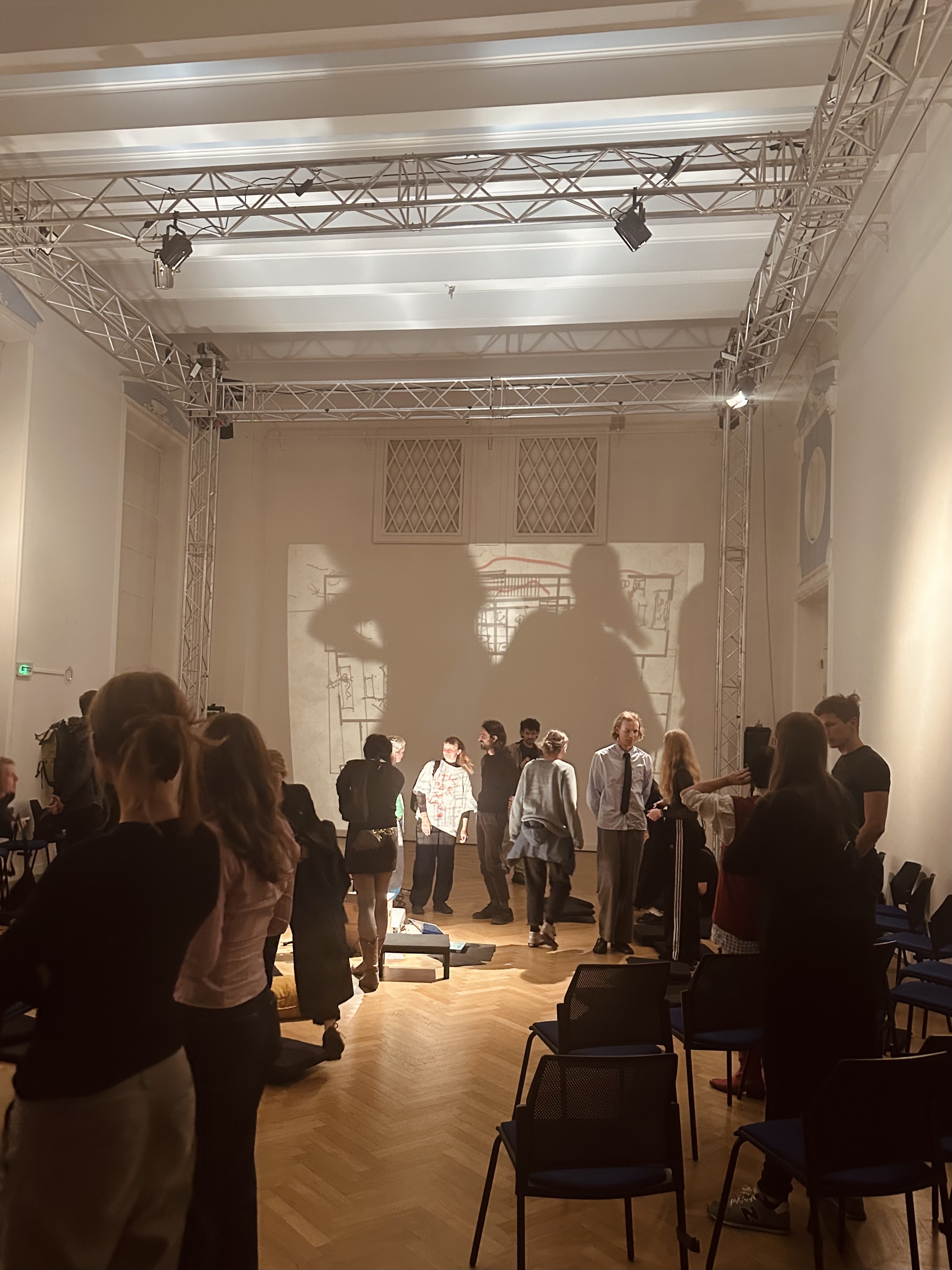
    Ely Daou & audience. Sakala 3 Teatrimaja, Tallinn, Estonia. Photo by author, 2025.

    By mapping out the spaces in which Daou lived throughout his childhood through floorplans, we trace back memories. His relationship with the other: cigarettes inside a bathroom, a picture of his grandfather on the wall. His participation within a collective: specific seats at the dinner table. The reliving of emotion: smoking on the balcony with his mother. His own personal history, room by room. Space by space. Daou inhabited the space physically, now, he brings space to life emotionally through memory. Daou’s use of space gently persuades the other, the collective and mindfulness through connection, relationship and emotion. All woven together through memory, reflection.

    From my own experience with this performance, the viewer builds a relationship with Daou. Smiles and other reactions can be seen throughout the audience as his formative events unfold. His ability to transcend the physical, material world and into the immaterial, emotional world allowed his whole audience to build a relationship with him. Daou described the apartments through floorplans, the furniture in the rooms and the relationships he shared with family on occasions in those rooms. Daou’s art of being reflective on these experiences, his exploration of himself shows us how mindfulness can reconnect us with ourselves, with what is important to us and our relationship with the world around us.

    For Daou, these recollections, however, are more than just memories. They hold a metaphysical arc as embodied memories that shape our collective sense making processes of who we are, who we become and how we interact with others (Mandalaki & Daou, 2021). By being more than a case of ‘what happened’ – these recollections serve as an active stance of remembering, reconstructing the self in relation to power structures, histories and more deeply, the worlds inequalities. Daou’s wider search for social justice, especially through the lens of feminism, invites questions not just about gender, but also about what it means to be human in this world (Mandalaki & Daou, 2021).

    Through the performance of ‘Cognitive Maps’, I see the method Daou creates holds the space for marginalised identities to share stories, regain agency and challenge oppression. By this I mean memory work has the capacity to bring to life and clarify the structures in which we inhabit, the frameworks that map our lives. This is not a negative perspective but a liberating one. Memory, guided through architectural details in Daou’s performance, has the ability to bring to life the ‘invisible visible’ of space that is so characteristic of our existence. It has the ability to reveal identity making processes and how cultural, political, historical events shape us through the environments in which we live. Through the equation, memory work allows us to understand how our consciousness comes into being by understanding both the collective and the other through experiences that have shaped us and our psyches.

    What matters most is these tools Daou has developed for self-reflection, self-understanding – mindfulness – allow us to understand his personality. Through the expression of his memories, the audience begin to understand Daou – we slowly begin to see him and the environment in which he was formed. Daou dissolves the distance between artist, art and his audience in a subtle and gentle way. The space we explored with Daou’s guidance is deeply personal. We are fortunate enough to have been shown what actually matters – connection, relationships, memory and the exploration of the self through the medium of space. An invisible that is impossible to ignore if we are mindful; an invisible that is now made entirely visible through Daou’s ‘Cognitive Maps: Chapter I’. A gift that allows us to connect, or reconnect, with our sense of self through the channels of the collective, the other through mindfulness.

    Conclusion

    The self cannot be conceived as an isolated essence but as a ratio of forces: collective, other, and the regulating work of mindfulness. To give primacy to any one variable is to encourage distortion. The value of this formula lies not in reducing the human condition to a simplified formula, but in clarifying the structural tensions that animate it.

    Daou’s ‘Cognitive Maps: Chapter I’ demonstrate how this tension is lived. Memory locates him in the collective of family, the other of objects and relations, and the mindful act of retracing space. Daou’s performance resists illusion and abstraction: it grounds authenticity in presence. Art, therefore, becomes a testing ground for the formula of the self, where the fragile balance of forces can be made visible.

    What follows is not a resolution but a point of notice. In an age of accelerated collectives and proliferating others, the danger is not merely the erosion of individuality but the challenge of maintaining presence. To understand this, the self must be shielded through mindful inhabitation of the world. Both Freud and Lacan remind us that the self is not a natural given but a product of formative encounters—with caregivers, with language, with institutions of learning and culture. These experiences, mediated through socialisation and education, anchor the individual in shared structures while also risking fragmentation. Mindfulness, in this sense, does not erase these variables but offers a way of inhabiting them reflectively. This formula is not an answer, but a guide, reminding us that authenticity is less about escaping the world through the collective or other but more about inhabiting it fully – together.

    References

    · Matisse, H. (1910) The Dance. Museum of Modern Art, New York City. Photograph by author, 2023.

    Sorolla, J. (early 20th century) Rocks and Sea. Museo Picasso, Málaga. Photograph by author, 2021.

    Calder, A. (1959) Big Red. Whitney Museum of American Art, New York.

    Daou, E. (2023–25) Cognitive Maps, Chapter I. Performance at SAAL Biennaal, Tallinn.

    Durkheim, É. (1912) The Elementary Forms of Religious Life. Paris: Alcan. [English trans. 1995, New York: Free Press].

    Freud, S. (1923) The Ego and the Id. Standard Edition, Vol. 19. London: Hogarth Press.

    Freud, S. (1930) Civilization and Its Discontents. Standard Edition, Vol. 21. London: Hogarth Press.

    Heidegger, M. (1927) Being and Time. Tübingen: Niemeyer. [English trans. 1962, Oxford: Blackwell].

    Judd, Donald. Donald Judd: Complete Writings 1959–1975. New York: New York University Press, 1975.

    Kabat-Zinn, J. (1990) Full Catastrophe Living: Using the Wisdom of Your Body and Mind to Face Stress, Pain, and Illness. New York: Delacorte.

    Lacan, J. (1949) ‘The Mirror Stage as Formative of the Function of the I’, in Écrits. Paris: Seuil. [English trans. 2006, London: W.W. Norton].

    Lacan, J. (1966) Écrits. Paris: Seuil. [English trans. 2006, London: W.W. Norton]. 

    Lacan, J. (1977) The Four Fundamental Concepts of Psychoanalysis. London: Penguin.

    Mandalaki, E., & Daou, E. (2021). Writing memory work through artistic intersections. Unplugged. Gender, Work & Organization, 28(5), 1912–1925. https://doi.org/10.1111/gwao.12720


    [1] Help, assist, provide context to our relations with each other. A framework of mutual understanding.

    [2] No negative connotations of the utilisation of ‘das Man’ are meant in this essay.