Tag: art-history

  • Mark Rothko – Seagram Murals

    Mark Rothko – Seagram Murals

    Seagram Murals Tate London

    Rothko’s Seagram Murals are a rejection of the institutions that birthed them. Their scale, colour and architecture produce durational feedback that echoes long after you have viewed them. A sigh, conviction and altered mood are expected. What the viewer is presented with isn’t a window, but a mirror – a tarnished one at that. Within this room, what is mirrored is a certain finality. A finality that makes you look inward.

    Both light and sound throughout the room is absorbed. The edges bleed into one another. Tones of blood, dried. Shades of coal, purple culminate in aftermath, spent energy and bruising. The colours, alongside the scale, create a silence. A silence that isn’t just heard but seen. Rothko brings the quiet of this room into being. As if you are walking into a confessional chamber. What these works conjure up is what the viewer carries with them into the room. The finality here is the sense that it is just you in the room and that you are alone. No beauty or inspiration takes hold. This is a room for contemplation.

    These pieces were commissioned for an elite dining room. Yet what we see here are sarcophagus-like shapes that dominate the canvases. Painted tombstones. These pieces would not complement a diner’s experience. Diners would be digesting their own emotions, preoccupations, mental states in front of these paintings. This was Rothko’s intention.

    The murals are a rejection of the idea that scale, luxury and productivity yield meaning within our lives. Rothko outwardly contests the economic and patronage institutions that commissioned them. These institutions value display, performance, visibility. Rothko sees the tragic failure of this kind of spectacle to satisfy the psyche, bringing this idea to canvas. Instead of comforting the diners, these pieces reassert inwardness. The material realm does not hold the answers. The answers, according to these paintings, are contained within.

    What strikes me most about these works is the alienation, the anomie that submerges the viewer. These pieces negate our surroundings. The combination of form and colour creates a finality of presence through this negation. It is this void that the grandeur of modernity tries to conceal. For Rothko, only interior truths can face the dilemma of our estrangement and alienation. These works, displayed together, provide the medium to achieve that.

    The Seagram Murals highlight the value Rothko placed on the deeper, more meaningful questions. The kind of questions that confront us. That is what the viewer is made to reconcile when faced with these canvases: Who are you?

    Disclaimer

    Everything written here is my own reflection — imperfect, interpretive, and open to disagreement. Nothing is meant to offend or exclude anyone. Art invites feeling and thought in equal measure; what’s offered here is simply one person’s encounter with it.

    References

    Ashton, Dore. About Rothko. Oxford University Press, 1983.

    Fischer, John. “Conversations with Rothko.” Harper’s Magazine, Nov. 1959.

    Morley, Simon. Writing on the Wall: Word and Image in Modern Art. Thames & Hudson, 2003.

    O’Doherty, Brian. Inside the White Cube: The Ideology of the Gallery Space. University of California Press, 1976.

    Rothko, Mark. The Artist’s Reality: Philosophies of Art. Edited by Christopher Rothko, Yale University Press, 2004.

    Rodman, Selden. Conversations with Artists. Capricorn Books, 1961.

    Sandler, Irving. The Triumph of American Painting: A History of Abstract Expressionism. Harper & Row, 1970.

    Tate Modern. Mark Rothko: The Seagram Murals. Exhibition Catalogue, Tate Publishing, 2008.
  • Kaljo Põllu – Sadness

    Kaljo Põllu – Sadness

    “It is not the consciousness of men that determines their being, but their social being that determines their consciousness.”

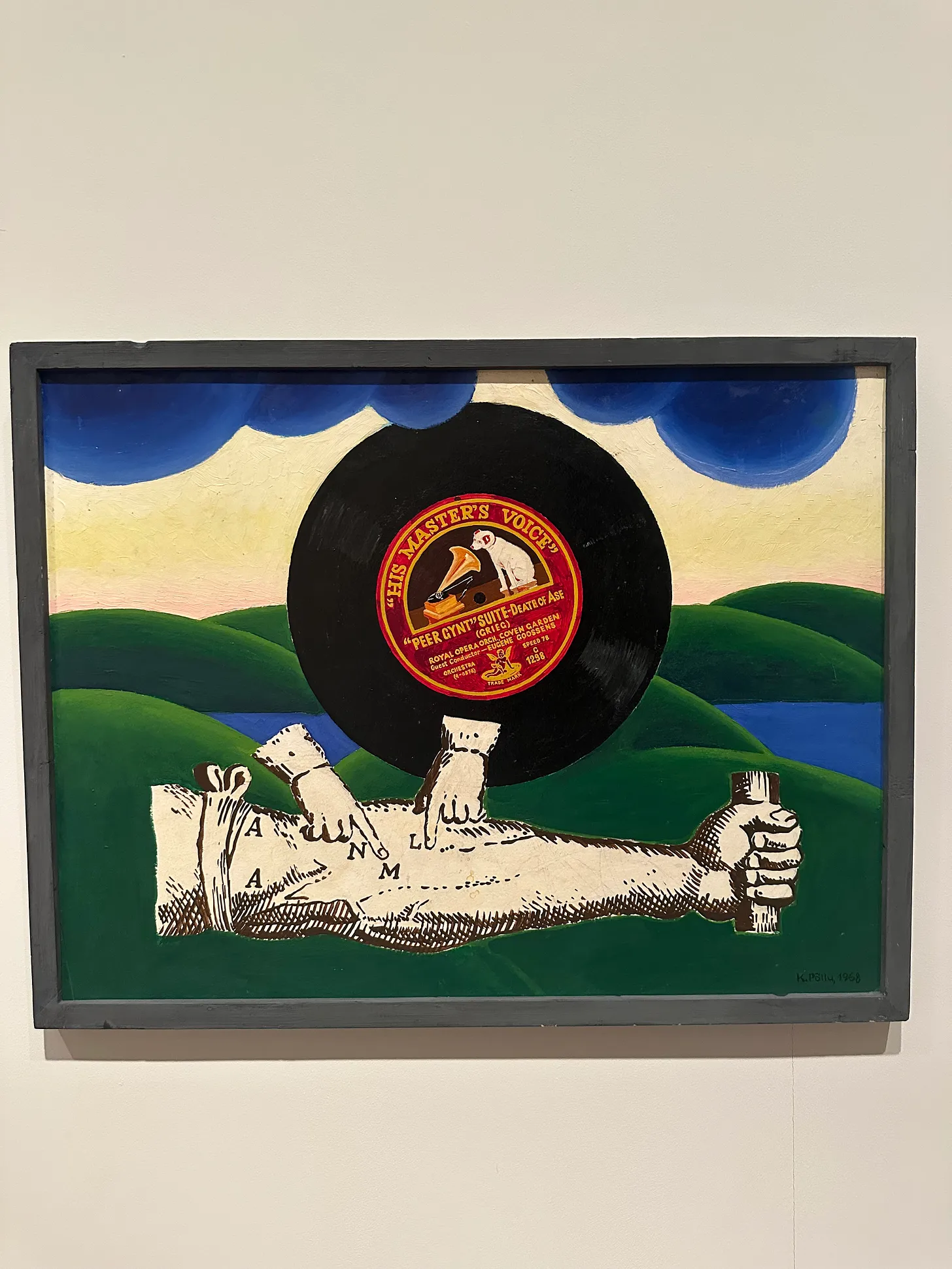
    Karl Marx determined that it is not ourselves that manifest our own consciousness. But instead, it is the institutional mainframes that surround us that determine our consciousness. Põllu’s Sadness highlights this antagonism, confronting the binaries of liberalism and authoritarianism against one another.

    Põllu’s work was born during the period of the Soviet occupation of Estonia; a period marked by ideological surveillance, censorship and the suppression of national and individual expression. But the antagonism that we see in this piece is a double entendre – one that confronts both liberalism and authoritarianism simultaneously. Whilst it directly critiques authoritarian control, it also implicates liberal capitalism, revealing how both systems manufacture consciousness through different modalities of conditioning.

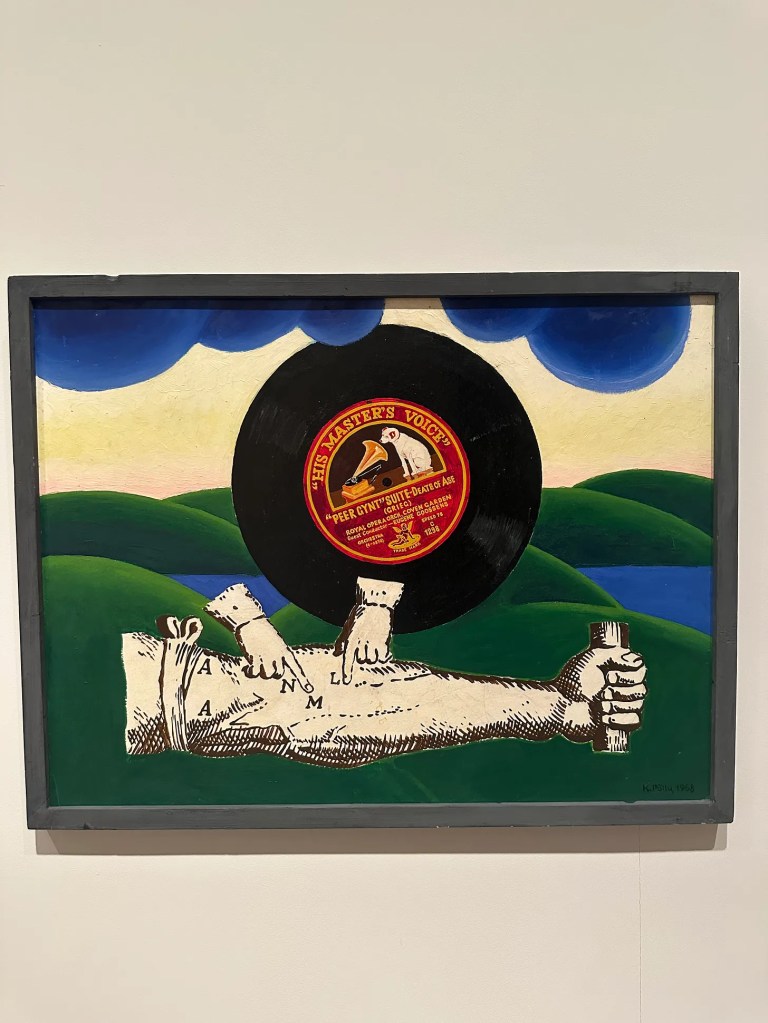
    At its core, what is communicated in this piece, despite the regimes in which we exist, our consciousness is never sovereign; it is produced. A product of the institutional realities in which we inhabit. What we see across the picture plane is a vinyl inscribed with “His Masters Voice”. This echoes the propaganda models pursued by the Soviets, yet it also references a Western music label that evokes the seductive machinery of capitalist media. A duality. The vinyl appears to have hands which are massaging specific points on the arm. As if the music being played, or “His Masters Voice”, knows exactly what to say and when to say it. In a word, conditioning. It is a metaphor for how mass culture and political messaging infiltrate the nervous system, turning human sensitivities into a site of conditioning.

    This conditioning holds a duality. That both capitalist and authoritarian systems of control condition their subjects in their own ways. Albeit the way in which this conditioning manifests is simply marketed and sold differently. Returning to the piece’s namesake, Sadness, perhaps Põllu was confronting the reality that we aren’t free under either regime type. Echoing the claim made by Rousseau, “Man is born free, but everywhere he is in chains”. This Sadness that Põllu communicates is one that could well characterise all our entire existences, the realisation that our supposed liberation, too, may in fact be another form of captivity.

    Disclaimer:

    Everything written here is my own reflection — imperfect, interpretive, and open to disagreement. Nothing is meant to offend or exclude anyone. Art invites feeling and thought in equal measure; what’s offered here is simply one person’s encounter with it.

  • Lee Krasner – Gothic Landscape

    Lee Krasner – Gothic Landscape

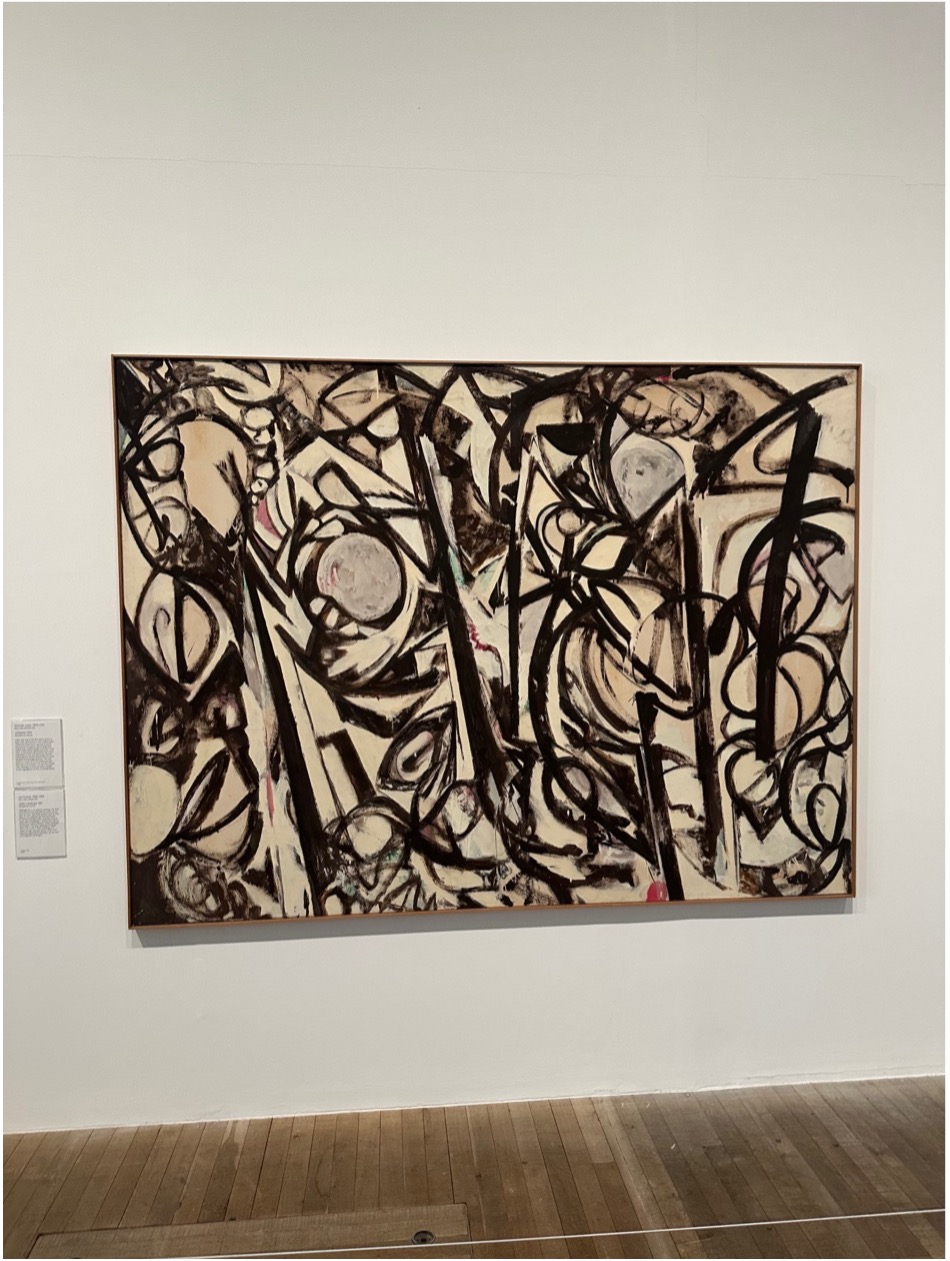
    Suffocation. A dense tangle of thick black gestural strokes, poles and circles jut against white and pastel tones. From the left and right side there are a set of opposites; dark and light contrasting against one another respectively. Krasner creates a set of binaries through both tone and structure. Light against dark, order against chaos, freedom against constraint. The overall effect is a violent rupture against our vision. The thick black poles slow down the movement of the eye creating a spatial hierarchy, separating each part of the canvas. This is the ‘push and pull’ method characteristic of Hans Hoffman’s works, Krasner’s mentor.

    Yet there is a marked difference between Hoffman’s work and Krasner’s. This difference is defined by their palettes. Hoffman can be seen to deploy primary colours. Krasner’s, on the other hand, feature an austere range of colours; black, white, neutral pastels. The energy Hoffman creates through colour is displaced in Krasner’s work. Instead, energy is created by way of the violence and contortion of form on the canvas. This difference in palette invites a deeper question regarding binaries. One that revolves around gender and the experience of female artists within the Abstract Expressionist paradigm.

    Where Hoffman explores primary colour, Jackson Pollock, Krasner’s husband, explored gestural freedom through automatism. The work by Pollock that is mirrored most in Gothic Landscape (1962) is Blue Poles (1952). Within this work there are harshly imposed poles that punctuate the canvas horizontally, creating a structural rhythm and tension. These poles create the same existential effect of binaries – chaos against order, freedom against constraint. Yet despite these tensions, Pollock’s freedom through automatism characterises the picture plain. In equal measure, Hoffman’s deployment of primary colour represents a freedom of palette. Within Krasner’s work, form is defined by constriction and suffocation which govern the viewer’s experience. The question that is created is whether the institutional confines surrounding these artists ultimately presented a different set of realities marked by gender. 

    In the Cold War art world, the institutions surrounding Abstract Expressionism were both patriotic and patriarchal. Pollock’s myth was institutionally cultivated as a symbol of American individualism and masculine power. Krasner, though equally sophisticated, was structurally confined to the periphery: the ‘wife-artist’. Krasner communicates the same freedoms and constraints that Pollock does, yet when filtered through gendered institutions, that freedom represents struggle. Krasner’s thick, suffocating layers depict psychic compression of operating inside the same institutions that Pollock does. 

    Both psyches emerge from the same formative mix of modernist education, American individualism, existential post-war trauma, but are modulated differently by institutional mediators of gender roles, visibility economies and art market patriarchy. Pollock found resonance within those institutions that rewarded excess. Krasner was shaped by constraint, producing a form of controlled chaos that critiques the very systems that exalted her husband. 

    Krasner’s Gothic Landscape is not merely expression but systemic diagnosis. Her work exposes how institutional hierarchies translate into psychic form. It recasts the mythology of Abstract Expressionism: what appeared as chaos in Pollock becomes critique in Krasner, a visual philosophy of constrained freedom. 

    Disclaimer:

    Everything written here is my own reflection — imperfect, interpretive, and open to disagreement. Nothing is meant to offend or exclude anyone. Art invites feeling and thought in equal measure; what’s offered here is simply one person’s encounter with it.